0.119u1 [Brian Troha]
0.74u2 [Phil Stroffolino, R. Belmont, Guru]
0.55 [Testdriver]
Bugs:
- Crash after defeating Round 3 in Vs. Computer Combat. Misc (ID 06302)
- Clone cybsledj: [possible] Cyber Sled (Japan) does not show japanese text. sjy96525 (ID 06102)
WIP:
- 0.182: Angelo Salese added input labels (Gun-, Missile- and Viewport Change Button) for Cyber Sled. Removed unused 4th button.
- 0.148u2: Changed description to 'Cyber Sled (World)'.
- 0.137u1: David Haywood limited the range of the analog inputs in Cyber Sled (the game glitches, causing you to move backwards if they hit the minimum / maximum). Setup default key mapping in Cyber Sled to be similar to other dual joystick 'tank' style games, eg. Assault, rather than the default keyboard mapping where the sticks appear to be swapped. Reworked the input ports a bit so that they include a common base rather than duplicating common inputs. Added default NVRAM.
- 0.120u1: Phil Stroffolino fixed missing 3D gfx in Cyber Sled.
- 0.119u1: Phil Stroffolino fixed Cyber Sled - Game now playable. Brian Troha added Cyber Sled (US). Changed TMS32025 CPU6 clock speed to 96MHz. Added 2x c67.roms (TMS32025 CPUs). Fixed rom names. Changed 'Cyber Sled' to clone 'Cyber Sled (Japan)'. Renamed (cybsled) to (cybsledj).
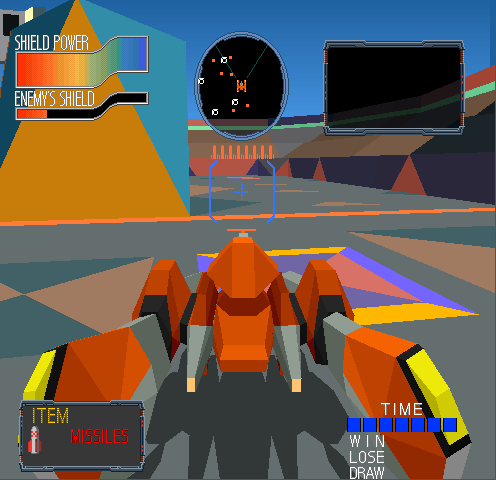
- 20th September 2007: Phil Stroffolino - Cybersled writes what looks like a block of video registers to ROM-mapped address space once each frame. This results in a lot of noise in the logs, but I wanted to know whether these actually had any effect on the video output. Scanning a few screenshots from the game running on real hardware, I immediately spotted one obvious difference: there's a little circular "radar" screen near the top, that's drawn from sprites. In the arcade screenshot, the background of this radar is translucent - you can see darkened polygons through it. Now, as it happens, this unemulated effect has nothing to do with those mysterious ROM writes (that may well be vestigal code). Each sprite has at least 4 priority values: 0: background - behind all polygons. 1: used for sprites that are inserted into the zbuffer; in Solvalou, this draws a mountain range in front of the polygon sky layer, and behind all other in-game polygons. 3: foreground - in front of all polygons. As it happens, sprites of priority 3 can be translucent or opaque, depending on the pens that are used. A similar technique is used in several 2d Namco titles to draw a shadows on top of tilemaps. In System21, this combination of sprite pen and priority causes an alternative bank of palette to be used when drawing the polygon layer. Supporting it adds a lot of nice in-game special effects. It's a neat little feature that finally explains how alternate (previously unused) banks of palette ram are used. A similar technique is used by games to flash the polygon layer alternate colors when the player is hit.
- 0.103u3: Fixed rom names.
- 0.97u1: Phil Stroffolino updated the Namco System 21 driver. Cyber Sled still don't work. It appears to use a different mechanism for uploading DSP code.
- 0.78u5: Phil Stroffolino improved polygon colors in CyberSled, better parsing of CyberSled's display list; title screen and ingame graphics now appear and are mostly correct and hooked up CyberSled input ports; they can be configured with the usual mechanism: hold the 'service' key while flipping the test dipswitch. Added 2nd Player.
- 0.74u2: Phil Stroffolino added 'Cyber Sled' (Namco 1993).
- 23rd August 2002: Phil Stroffolino reported some progress with the Namco System 21 driver, which supports Starblade, Air Combat, Cyber Sled and Solvalou. All games have full sound support thanks to R. Belmont. Starblade is fully playable, but the other games are preliminary and suffer from various graphics glitches and lack of input ports.
- 20th July 2002: R. Belmont submitted an update to the Namco C140 sound chip emulation, improving Cybersled and others though they aren't yet really playable.
- 0.55: Added (Testdriver) Cyber Sled. Known issues: Cyber Sled isn't updating DSP RAM (due to missing status reads).
- 20th August 2001: Guru - Phil Stroffolino made some progress with Cyber Sled (many aspects of the hardware not emulated yet).
- 14th August 2001: Guru - Arrived and dumped Cyber Sled (Namco 1993, System 21). Thanks to PCB-A-Holic for the PCB.
Other Emulators:
* Mjolnir
Recommended Games (Cyber Tank):
Rip Off
Pulsar
Tron (Tank stage)
Mega Zone
Regulus
Senjyo
Crater Raider
Grobda
Heavy Metal
Assault
Vindicators
Vindicators Part II
Aurail
Battle of the Solar System
Cyber Sled
Cyber Commando
Polygonet Commanders
T-MEK
Guardian Force
Zoids Infinity
Zoids Infinity EX Plus
Arcade Video game published 26 years ago:
Cyber Sled (c) 1993 Namco.
Piloting a colorful tank that slides over the surface like a 'Sled' in an arena of the future, the pilots fight for prestige and glory. Ending the game (either by winning or being eliminated) gives the player a rank and a letter grade to show how good you really are.
- TECHNICAL -
Cyber Sled was only available as a dedicated 2-player sit-down cabinet. The plastic mouldings around the screens and the twin joysticks give the illusion of piloting a futuristic tank. The player-one position is all blue, and the player-two position is all red. Unlike later sit-down style 'driving' cabinets, the seats are not adjustable.
Runs on the Namco System 21 hardware.
Main CPU: (2x) Motorola 68000 (@ 12.288 Mhz), M6809 (@ 3.072 Mhz), HD63705 (@ 2.048 Mhz), (2x) TMS32025 (@ 24 Mhz)
Sound Chips: C140 (@ 21.39 Khz), YM2151 (@ 3.57958 Mhz)
Control: 2 Sticks per Player
Buttons: 5 Buttons per Player. 2 Fire, 2 Rocket, 1 View.
- TRIVIA -
Cyber Sled was released in September 1993.
Victor Entertainment released a limited-edition soundtrack album for this game (Cyber Sled : Namco Game Sound Express Vol.10 - VICL-15024) on 21/01/1994.
- SERIES -
1. Cyber Sled (1993)
2. Cyber Commando (1994)
- STAFF -
Music composed by: Shinji Hosoe
- PORTS -
* CONSOLES:
Sony PlayStation (1995)
Sega Saturn [Unreleased Prototype]
- CONTRIBUTE -
Edit this entry: https://www.arcade-history.com/?&page=detail&id=559&o=2