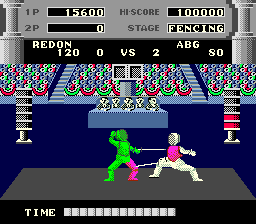
Arcade Video game published 35 years ago:
Great Swordsman (c) 1984 Taito Corp.
Great Swordsman is a 1-on-1, side view, sword fighting game that spans 3 types of sword fighting : Fencing, Kendo, and gladiator-style combat.
- TECHNICAL -
Board Number : M6100032A
Prom Stickers : AC#/AC#/AA
Main CPU : (2x) Zilog Z80
Sound CPU : Zilog Z80
Sound Chips : (2x) General Instrument AY8910, OKI MSM5205
Players : 2
Control : 2-way joystick
Buttons : 3
- TRIVIA -
Great Swordsman was released in September 1984 in Japan.
There are a total of 3 stages in Great Swordsman, with a total of 15 opponents. Once you finish the last opponent, the game starts over from the beginning at a much harder skill level (you keep your points, however). Between each stage, there's a bonus stage that allows you to rack up points by blocking an archer's arrows. Following are the stage and opponent names :
* Stage 1 - Fencing
Opponent 1 : Appels
Opponent 2 : Redon
Opponent 3 : Fantin
* Bonus Stage 1 - Block the Archer's Arrows
* Stage 2 - Kendo
Opponent 1 : Senpou
Opponent 2 : Jihou
Opponent 3 : Chuken
Opponent 4 : Fukusho
Opponent 5 : Taisho
* Bonus Stage 2 - Block the Archer's Arrows
* Stage 3 - Roman
Opponent 1 : Mars
Opponent 2 : Hermes
Opponent 3 : Apollo
Opponent 4 : Helios
Opponent 5 : Orion
Opponent 6 : Uranus
Opponent 7 : Zeus
The names of the opponents in this game are interesting in that each stage's names are terms/names used either in that art form, country of origin, or era in which the art form was related to. Following are reasons (and perhaps guesses) as to why they used the names they did :
Appels - A quick stamp of the foot used in fencing as a feint to produce an opening.
Redon - Redon, Odilon (1840-1916). French painter and graphic artist, one of the outstanding figures of Symbolism.
Fantin - Fantin-Latour, Henri (1836-1904). French painter and lithographer.
Senpou - The first 'player' in a Kenpo match-style competition to line up (also spelled "Senpo").
Jihou - The second 'player' in a Kenpo match-style competition to line up (also spelled "Jiho").
Chuken - The third 'player' in a Kenpo match-style competition to line up.
Fukusho - The fourth 'player' in a Kenpo match-style competition to line up.
Taisho - The last 'player' in a Kenpo match-style competition to line up.
Mars - God of war
Hermes - God of boundaries and of the travellers who cross them (such as bringing newly-dead souls to the underworld, Hades)
Apollo - God of music, archery, healing, light, truth, etc...
Helios - God of the Sun
Orion - God, the hunter
Uranus - God of the Sky
Zeus - God of the Earth and Ruler of Mount Olympus
On stages 1 and 2, any 2 out-of-bounds results in a loss of a point. It is impossible to go out-of-bounds on stage 3. Stage 1 requires 5 points per match, with 3 matches. Stage 2 requires 2 points per match, with 5 matches. Stage 3 requires 1 point per match with 7 matches. Simultaneous hits do not count for either player. On Stage 1, a tie results in a win for you! (It is impossible to tie on stages 2 and 3, based on their point structures).
- TIPS AND TRICKS -
* Trick : By continually hitting your opponents sword, you can cause them to lose their sword. Their sword ends up impaling their head!
* Trick : Killing your opponent very quickly with a strike to the head can cause their helmet to fly off.
* Tip : High and mid strikes in succession can easily force your opponent out-of-bounds.
* Tip : On stage 1, holding away from your opponent while striking increases your weapon return speed.
* Tip : On stage 3, use the far right wall as a defense, since you can't step out-of-bounds.
- PORTS -
* CONSOLES:
[EU] Microsoft XBOX (oct.14, 2005) "Taito Legends"
[EU] Sony PS2 (oct.14, 2005) "Taito Legends [Model SLES-53438]"
[US] Microsoft XBOX (oct.25, 2005) "Taito Legends"
[US] Sony PS2 (oct.25, 2005) "Taito Legends [Model SLUS-21122]"
[KO] Sony PS2 (jul.18, 2006) "Taito Legends [Model SLKA-15056]"
[JP] Sony PS2 (mar.29, 2007) "Taito Memories II Gekan [Model SLPM-66713]"
* COMPUTERS:
[EU] PC [MS Windows, CD-ROM] (oct.14, 2005) "Taito Legends"
[US] PC [MS Windows, CD-ROM] (nov.10, 2005) "Taito Legends"
- CONTRIBUTE -
Edit this entry: https://www.arcade-history.com/?&page=detail&id=1012&o=2