Arcade Video game published 37 years ago:
Millipede (c) 1982 Atari.
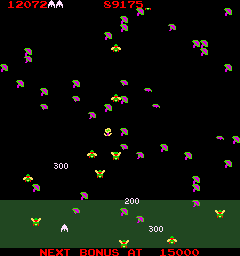
Millipede is a 1- or 2-player game with a color raster-scan video display. The game action takes place on a playfield filled with mushrooms, flowers, and deadly DDT bombs. The player tries to destroy a variety of insects that drop from the top of the screen or enter from the sides of the screen, most of them to attack the player. The player controls a bow-shaped vehicle called the Archer. The object of the game is to shoot and destroy as many objects as possible for a high point score, before the player's lives are all used up.
Player control consists of a Midi Trak-Ball control and a FIRE button. The Archer is moved by rotating the Midi Trak-Ball control. The Archer can be moved in all directions, but only within the bottom fifth of the screen. However, the Archer must move around mushrooms, flowers, and DDT bombs, since these are fixed and not 'transparent' objects. Pressing the FIRE button causes the Archer to emit an arrow that travels upward. The Archer may fire one or many arrows (by holding down the FIRE button constantly). But only one arrow will appear on the screen at a time.
A player may start a game at an advanced level of play and receive bonus points for starting play at that level.
Gameplay begins with a playfield of randomly placed mushrooms and DDT bombs. A Millipede enters at the top center of the screen and starts snaking its way across the screen. The Millipede changes direction when it runs into a fixed object in the playfield (mushroom, DDT bomb, or flower), or when it reaches the side boundaries of the playfield.
When a segment of the Millipede is shot, it is destroyed and a mushroom appears where that segment was shot. When shot, the Millipede breaks into two smaller Millipedes, each with its own head. When a Millipede reaches the bottom of the screen, it starts back up, but remains within the area of the Archer (the bottom 5th of the screen).
If a Millipede reaches the bottom of the screen without being shot, it releases its tail. This tail changes into a new head. Also to provide the player a challenge, if a Millipede is still alive when it reaches the bottom, new heads will enter the screen almost at the bottom of the sides. More of these heads will appear as time progresses.
An attack wave is complete when all Millipede segments are destroyed. The screen then scrolls down one line. At the 9th attack wave, when the Millipede with only four segments enters from the top of the screen, the screen will scroll down every two seconds. The only way a player can stop the scrolling screen is to shoot a DDT bomb or destroy the entire Millipede.
It takes four shots to destroy a mushroom. After the fourth attack wave of each wave cycle, the entire playfield of mushrooms changes. Some mushrooms die and new mushrooms grow where there were none before. A mushroom next to a DDT bomb becomes poisoned (See Tips and Tricks below for complete details).
When a Millipede runs into a poisoned mushroom, two things happen: its head changes color, and it changes direction and falls vertically to the bottom of the screen.
DDT bombs explode when hit by an arrow. Any object near the bomb is engulfed by the explosion. Insects are worth three times their normal point value if they are destroyed by the explosion.
Spiders appear in any round. They move in a random pattern on the bottom third of the screen. As the player's score increases, the range of the Spider decreases, until it is confined to the bottom fifth of the screen. Also, more Spiders enter as the game progresses. A Spider destroys any mushroom or flower it moves over. Depending on a special option switch setting, the Spider moves slowly until a player reaches a specific score, and then it speeds up. If the Archer and a Spider collide, both are destroyed.
When a Millipede with fewer than eleven segments appears, an Earwig enters the screen from either side, moving at a relatively slow speed. As the player earns more points, the Earwig's speed increases. If an Earwig passes over a mushroom, it poisons the mushroom.
When a Millipede with fewer than ten segments appears, a Dragonfly enters at the top of the screen. The Dragonfly moves in a zig-zag pattern and its speed increases as the player's score increases. As the Dragonfly moves, it leaves a trail of mushrooms behind.
When a Millipede with fewer than nine segments appears, a Mosquito enters at the top of the screen and flies in a diagonal pattern. The Mosquito's speed increases as the player's score increases. When a Mosquito is destroyed, the screen scrolls up one row.
Beetles appear randomly after the first wave. They enter from the sides of the screen near the bottom, travel down to the bottom of the screen, and walk at least half way across the bottom. Then the Beetle travels up and exits at the side of the screen. If a Beetle passes over a mushroom, the mushroom changes into a flower. Flowers cannot be destroyed by the Archer's arrows. Depending on a dip switch setting, the number of Beetles appearing on the screen and the speed of the beetles increase as the player's score increases. When a Beetle is destroyed, the screen scrolls down one row.
Bees may fall from the top of the screen during any round. As the Bee falls, it leaves a trail of mushrooms behind. The Archer must hit a Bee twice to destroy it; the first shot just speeds it up.
An Inchworm may appear when a Millipede with fewer that eleven segments appears. The Inchworm travels from one side of the screen to the other side. It moves slowly until the player's score reaches 80,000 points. Then it speeds up. If the Archer destroys the Inchworm, all insects will slow down for about three and one-half seconds.
After a Millipede of one, three, five, seven, or eleven segments has been destroyed, an insect bombing raid occurs. A raid may have only Bees, Dragonflies, Mosquitoes, or a mixture of all three.
- TECHNICAL -
Millipede came in two different form factors - an upright and a cocktail table - and it was also available as a conversion kit for "Kangaroo", "Dig Dug", and "Arabian".
* The control panel features a trackball to move the Archer around the player area and a FIRE button for firing the arrows.
* Millipede's trackball is larger in diameter than that of "Centipede", but smaller than that of the upright and cockpit versions of "Missile Command". All of the trackballs are prone to wear and tear, but replacement parts are readily available.
* The upright version, by far the most common, is in a white cabinet that is rather strangely shaped. It really accents the speaker area in a way that no other games did. The game features ornate painted sideart of a huge orange millipede along with a hunter inside a forest scene. That graphic isn't just on the sides either, it continues all the way around the front of the machine as well. The control panel is dark and rather plain. It has the trackball, the FIRE button, some game instructions, and a few graphics of leaves. The marquee for this title shows a hunter clad in red, firing a long bow at an orange millipede.
* The cocktail version is black and woodgrained, and mildly decorated with light blue graphics under the glass and on the control panels. This version has two control panels, on opposite sides of the cabinet; in a 2-player game, the players sit across from each other, and the screen's image flips over to face whichever player is currently controlling the Archer.
Game ID : 136013
Main CPU : MOS Technology M6502 (@ 1.512 Mhz)
Sound Chips : (2x) POKEY (@ 1.512 Mhz)
Screen orientation : Vertical
Video resolution : 240 x 256 pixels
Screen refresh : 60.00 Hz
Palette colors : 32
Players : 2
Control : Optical trackball
Buttons : 1 (FIRE)
- TRIVIA -
Millipede was released in November 1982. 8,690 upright units were produced. Also, 1,300 cocktails models were build.
Sequels to arcade games can be a 'hit and miss' thing. Taito was able to make a successful sequel to its "Space Invaders" game by releasing "Space Invaders Part II". Atari also attempted to make a sequel to its hit "Asteroids" called "Asteroids Deluxe". Unfortunately, the sequel was not received well and Atari took a loss with it. Atari had another runaway hit in 1980 called "Centipede". The game basically involved having the player take out insects and mushrooms that dotted the playing screen. Taking another chance, Atari released a sequel in 1982 called Millipede. Fortunately, Millipede received a better reception then "Asteroids Deluxe" did as a sequel and it did fairly well at the arcades. Other games that Atari released such as "Dig Dug", "Gravitar", and "Pole Position" may have also helped the sequel along. The game play was essentially the same as the original.
If you go into test mode, you will see a hidden 'Logg' sprite which refers to the game's programmer, Ed Logg.
Originally called 'Centipede Deluxe'. Here are the main differences between Millipede and "Centipede" :
* Instead of the Centipede and three enemies, you now have to deal with the Millipede and seven enemies.
* In addition to the Bee dropping mushrooms, the Dragonfly also drops them. The difference between the two enemies is that the Bee goes in a straight line from top to bottom while the Dragonfly zig-zags across the screen from top to bottom.
* Beetles turn mushrooms into flowers which can only be destroyed with DDT bombs or by Spiders.
* On some screens, some of the mushrooms will disappear while others grow in other random places.
* The player character is now an Archer, as it now shoots arrows instead of laser-type shots.
* The screen advances down one level after each round is completed or for each Beetle that is hit. This will reveal other things when a new top level is revealed. Hitting a Mosquito causes the screen to advance up by one level.
* Different events are based on how many segments the Millipede starts with. A segment is defined as not being a separate head.
* DDT bombs have been added to help you take out areas of bugs, flowers, and mushrooms. DDT was a chemical that was banned in the 60's for pest control.
* A new bonus setting has been implemented. It works depending on what the machine is set at for gaining bonus Archers. Once you cross that threshold multiple, you can start a new game from that score minus the original bonus score. The score tops out at 300,000 points. You have 30 seconds after your game ends to choose to do this. It works like this :
1) The maximum level a player can start at is one level lower then the last free Archer they received. For example, you receive a free Archer every 20,000 points. If you achieved a score of 50,000 points, then the last free Archer you received was at 40,000 points. Going one level lower, you can either start with a bonus of 0 or 20,000 points. It works the same for free Archers awarded at 12,000 or 15,000 points.
2) The player will also be allowed to start a new game at a bonus level. Again, depending on what the machine settings are for free Archers will determine this bonus. The bonus will be 0, 1, 2, or 3 times whatever the score required is for a free Archer (i.e. 0, 12,000, 24,000, or 36,000 points to name one). You will have 10 seconds to make a decision.
* There are more score-dependent settings for the game. This means more enemies will do different things depending on the player's score.
* Millipede cycles back and forth with head to body ratio instead of just having heads like Centipede does.
James Schneider holds the official record for this game with 6,995,962 points.
A Millipede unit appears in the 1983 movie 'Joysticks' and in the 1988 movie 'Arthur 2 - On the Rocks'.
In 1982, Atari released a set of 12 collector pins including : "Missile Command", "Battlezone", "Tempest", "Asteroids Deluxe", "Space Duel", "Centipede", "Gravitar", "Dig Dug", "Kangaroo", "Xevious", "Millipede" and "Food Fight".
- SCORING -
Millipede (body segment) : 10 points
Millipede (head segment) : 100 points
Spider : 300, 600, 900, 1,200 points (Points increase the closer the Spider is to the player's Archer when shot)
Earwig : 1,000 points
DDT Bomb : 800 points
Dragonfly : 500 points
Mosquito : 400 points
Beetle : 300 points
Bee : 200 points (Takes 2 hits. First hit speeds it up, second hit destroys it)
Inchworm : 100 points
Mushrooms & Poisoned Mushrooms : 1 point (Takes 4 hits to destroy).
When the mushroom patch is reset after the Archer is destroyed, each partially destroyed mushroom, poisoned mushroom or flower that is restored awards the player 5 bonus points.
Enemies killed inside DDT blasts are worth three times their normal score. The exception to this are Spiders which are worth 1,800 points when killed by DDT and enemies on the raids which are worth their normal (progressive) point values.
Raids : Normal points for the first raiding insect killed. Additional kills on raiding insects are worth 100 points more than the previous one, up to a maximum of 1,000 points each.
- TIPS AND TRICKS -
* Hints :
1) Destroy mushrooms near the bottom of the screen.
2) Destroy the DDT bomb when the Millipede is beside it.
3) When a Millipede hits a poisoned mushroom, it changes direction and falls vertically. Anticipate the place the Millipede will fall, because shooting it as it falls destroys all its segments.
* Know Your Enemies : This is the single most important aspect of this game. If you don't know how each of the enemies behave, you won't last long. The enemies are :
1) Millipede (Body and Head) - The main target of the game. Its role is basically identical to that of the Centipede in "Centipede". It goes back and forth across the screen and will drop to the next level when it encounters a mushroom, flower, DDT bomb, or the side of the game screen. It will go all the way to the bottom when its head hits a poisoned mushroom.
2) Spider - It appears from the top left or right of the player area. Its role is basically the same as in "Centipede". It will either bounce across the player's area at 45-degree angles or bounce in at a 45-degree angle, bounce up and down a couple of times, go to the middle at a 45-degree angle, bounce up and down a couple of times, then finally go to the side opposite its entrance (at a 45-degree angle), bounce up and down, then exit the area. It destroys flowers and mushrooms it passes over. In later stages, multiple Spiders will appear.
3) Bee - It can appear in any attack wave. Its role is identical to that of the Flea in "Centipede". It falls from the top of the screen to the bottom, randomly depositing mushrooms along the way. A Bee takes two shots to kill. The first shot makes it angry and causes it to speed up its descent. It will usually appear when you have cleared out most of the mushrooms in the player area.
4) Beetle - It appears randomly after the first wave. It enters from the left or right side of the screen, then goes to the bottom. It travels at least halfway along the bottom before going up to its original entry level. It then exits from the side opposite from which it entered. All mushrooms in its path are converted to flowers which are immune to the Archer's arrows. Hitting a Beetle causes the screen to go down one level.
5) Earwig - It appears when the Millipede begins with less then eleven body segments. Its role is identical to that of the Scorpion in "Centipede". It goes across the screen and poisons any mushrooms in its path.
6) Inchworm - It first appears when the Millipede begins with less then eleven body segments. Hitting one causes all enemies on the screen to slow down for about three seconds.
7) Dragonfly - It appears when the Millipede begins with less then ten body segments. It goes in a zig-zag pattern from top to bottom leaving a trail of mushrooms in its wake.
8) Mosquito - It appears when the Millipede begins with less then nine body segments. It flies in a diagonal pattern from the upper left or upper right corners. Hitting one causes the screen to go up one level.
* The Millipede will start out as a head with eleven body segments in the first wave. Wave 2 will be a head with ten body segments and a head that enters from the opposite side. Wave 3 will be a head with nine body segments and two heads that enter from opposite sides. This progression keeps going until Wave 12 where you have twelve heads. The cycle will then start over in Wave 13. This cycle occurs every 12 distinct waves.
* You must clear the first Millipede wave only once. Then, until your score reaches 20,000 points, you must complete each subsequent Millipede wave twice - first as the Millipede moves slowly towards you, then as it moves fast. After your score reaches 20,000 points, each Millipede wave will only need to be completed once.
* Shooting the Millipede can have two effects :
1) If you shoot the head, that part turns into a mushroom and the next segment becomes the new head and the Millipede will travel in the opposite direction (since it hit the newly-created mushroom).
2) If you shoot the middle of the body, then the segment hit will become a mushroom. The existing Millipede will continue in the same direction. The new Millipede will develop a head at the next segment after the break and head off in the opposite direction.
* A good strategy to ensure you destroy the Millipedes in one stroke and to keep the Bees at bay is to create 'mushroom corridors'. Mushroom corridors are basically corridors between two rows of mushrooms where you can funnel the Millipede down and destroy it when it is moving head-first at your Archer.
* In reference to the above 'mushroom corridors', keep in mind that after the fourth wave of each cycle, the mushrooms will undergo a period of 'Growth' that determines whether they stay alive or die in accordance with a modified version of the 'life' algorithm. The rules are as follows:
1) Any mushroom with fewer than two neighbors dies, as if by loneliness.
2) Any mushroom with more than three neighbors dies, as if by overcrowding.
3) Any mushroom with two or three neighbors lives, unchanged, to the next generation.
4) Any empty space with exactly three mushroom neighbors comes to life.
5) Any mushroom adjacent to a DDT bomb becomes poisoned.
6) Any non-poisoned mushroom adjacent to a poisoned mushroom dies.
7) Flowers cannot die, but do count as neighbors towards the growth of mushrooms.
After this period of 'Growth', you may have to clean up the area since some of your corridors may have been affected by this change.
* Watch out for the Spiders. They enter at either the top or bottom corners. Your Archer may be in the way if this happens. In addition to collisions, the Spiders wipe out all mushrooms that are in its path. This can create problems when you are creating mushroom corridors. It can also cause Bees to appear since you won't have many mushrooms in the player area. In later rounds, multiple Spiders may appear in the player area.
* At the beginning of an attack wave, take a quick look to see how many segments the Millipede has. This will determine the behavior of enemies on that or subsequent attack waves.
* Five different times during the cycle of twelve millipede attack waves, you will be bombarded by a swarm of insects. These waves are a major source of points.
After the 2nd wave : Bee raid
After the 6th wave : Dragonfly raid
After the 8th wave : Mosquito raid
After the 10th wave : Bees and Dragonflies raid together
After the 12th wave : Bees, dragonflies, and mosquitoes raid together
During these raids, special scoring applies for shooting Bees, Dragonflies, and Mosquitoes. Each insect kill of those types (even types not actually swarming, for example a single Bee randomly dropping during the Mosquito swarm) is worth a minimum of 100 points more than the previous kill, to a maximum of 1,000 points. Triple scoring from DDT applies as well, so DDTing a Mosquito or Dragonfly will immediately max the raid value at 1000, and DDTing a Bee will register at least 600.
It's very important not to die during one of the raids. If you stay alive, a raid can be worth up to 30,000 points later in the game. To prepare for a raid, don't shoot the last head until any Spiders and Beetles are near the side and leaving the screen. Clear a path to a DDT bomb if possible, so you can use it to kill several insects at once. It will quickly build their value to the maximum of 1000 points each.
Concentrate on one thing - shooting as many bugs as you can. Don't waste time clearing mushrooms until after the raid is over. As your score increases, the length of the raids also increases, making them worth lots of points.
* On the 9th wave, the mushrooms begin scrolling down very quickly, roughly one row every two seconds. They don't stop unless you kill the Millipede, shoot a DDT bomb, or lose a life. You have to do one of these three things quickly, or you'll be overwhelmed by mushrooms on the bottom.
First try to hit a DDT bomb. It's a good idea to clear a path to one before the wave starts. If you can't use a DDT, try to kill the Millipede before the mushrooms get too low. As a last resort, die on purpose.
The scrolling wave follows the Mosquito raid. If you can shoot a lot of Mosquitoes in the raid, the mushrooms scroll way up the screen, and you'll have plenty of time to kill the Millipede while the mushrooms come back down. Remember, if you scroll the mushrooms way up the screen, you won't be able to fire very fast. You'll have to take single shots, making sure you hit the Millipede each time.
* You can have a maximum of 4 DDT bombs on the screen at any given time. Wait until either the Millipede is right next to one or there is a heavy concentration of enemies before setting it off.
* Beetles can cause a lot of problems if they aren't dealt with quickly. Of course, if you have your mushroom corridor set up, they may be a blessing. Since they create flowers in their path that are immune to your Archer's arrows, this would help prevent you from shooting them accidentally. Of course, you still have to worry about the Spiders and DDT bombs.
* Keep track of where the Earwigs move across the screen. As soon as a Millipede's head hits a poisoned mushroom, it will immediately head for the bottom of the screen. The only way to stop this headlong plunge is to shoot it in the head. Unlike in "Centipede", the Millipede's head turns a different color when it is heading directly for the bottom of the screen. In the later attack waves, it is not uncommon to have multiple Earwigs going across the screen. They also provide the most points in the game.
* If you get unlucky and let the Millipede into your area, you need to destroy it before it gets to the bottom of the player area. Once it reaches the bottom, it will ascend again and remain in the player area. If it does reach the bottom of the player area, another head will come out from the opposite side to start its back and forth march across the screen. This will continue until you destroy all the Millipede parts in the player area or until your Archer is destroyed.
* If your Archer gets destroyed, all partially-destroyed mushrooms and all poisoned mushrooms are reset. Flowers created by Beetles are also changed back into mushrooms. You then start at the beginning of the wave you got killed on.
* Depending on the difficulty the machine is set up at, the following events occur :
1) At Easy, the Spider moves slowly up to 10,000 points. At Hard, the Spider moves slowly up to 5,000 points.
2) At Easy, the Beetle moves slowly up to 400,000 points and four Beetles appear in each round after 500,000 points. At Hard, the Beetle moves slowly up to 300,000 points and four Beetles appear in each round after 350,000 points.
3) At Easy, Millipede heads enter from the sides of the screen at timed intervals. At Hard, Millipede heads enter from the sides of the screen faster than at Easy.
4) Regardless of setting, the Inchworm will move faster after the player reaches 80,000 points.
5) All other enemies move at their same speeds.
- SERIES -
1. Centipede (1981)
2. Millipede (1982)
3. Centipede (1998, PC CD-ROM; 1999, PlayStation/Dreamcast; 2001, Apple Macintosh)
4. Centipede Infestation (2011, Wii/3DS)
5. Centipede Origins (2012, App Store/Android)
- STAFF -
Designed & programmed by : Ed Logg (ED )
Attract mode programming: Mark Cerny (MEC)
Also worked on Millipede : Dave Snyder
From High Score table: (BBM), Franz Lanzinger (FXL), Doug Snyder (DUG), Dona Bailey (DCB), (DEW), (DFW)
- PORTS -
* CONSOLES:
[US] Atari 2600 (1983) "Millipede [Model CX26118]"
Atari 2600 [EU] (1983) "Millipede [Model CX26118P]"
[US] Atari 5200 "Millipede [Model CX5248]" : Release cancelled
Atari XEGS
[JP] Nintendo Famicom (oct.1, 1987) "Millipede [Model HAL-ML]"
[US] Nintendo NES (oct.1988) "Millipede [Model NES-ML]"
[US] Sony PlayStation (dec.31, 1997) "Arcade's Greatest Hits - The Atari Collection 2 [Model SLUS-00449]"
[EU] Sony PlayStation (june.1998) "Arcade's Greatest Hits - The Atari Collection 2 [Model SLES-00712]"
[US] Sega Dreamcast (jul.2, 2001) "Atari Anniversary Edition [Model T-15130N]"
[US] Microsoft XBOX (nov.16, 2004) "Atari Anthology [Model 26084]"
[US] Sony PS2 (nov.22, 2004) "Atari Anthology [Model SLUS-21076]"
[EU] Microsoft XBOX (nov.26, 2004) "Atari Anthology"
[EU] Sony PS2 (feb.18, 2005) "Atari Anthology [Model SLES-53061]"
[JP] Microsoft XBOX (aug.4, 2005) "Atari Anthology [Model B7X-00001]"
Microsoft XBOX 360 [XBLA] [US] [EU] (may.2, 2007) "Centipede / Millipede"
[US] Sony PlayStation 4 (oct.18, 2016) "Atari Flashback Classics Vol.1"
[US] [EU] Microsoft XBOX One (nov.1, 2016) "Atari Flashback Classics Vol.1"
* HANDHELDS:
[US] Nintendo Game Boy (aug.1995) "Arcade Classic No. 2 - Centipede & Millipede [Model DMG-ACPE-USA]"
Nintendo Game Boy [UK] (aug.1995) "Arcade Classic No. 2 - Centipede & Millipede [Model DMG-ACPP-UKV]"
[US] Nintendo GBA (aug.15, 2005) "3 Games in One! Super Breakout - Millipede - Lunar Lander [Model AGB-B62E-USA]"
[EU] Nintendo GBA (sept.2, 2005) "3 Games in One! Super Breakout - Millipede - Lunar Lander [Model AGB-B62P-EUR]"
[US] Sony PSP (dec.19, 2007) "Atari Classics Evolved [Model ULUS-10325]"
[AU] Sony PSP (mar.7, 2008) "Atari Classics Evolved"
[US] Nintendo DS (mar.8, 2011) "Atari Greatest Hits Vol.2 [Model NTR-P-PR7E-USA]"
* COMPUTERS:
[US] Atari 800 (1983) "Millipede [Model RX8048]"
[EU] Atari ST (1986)
Tandy Color Computer [US] (1987) "Kingpede"
[US] PC [MS Windows, CD-ROM] (apr.4, 1998) "Atari Arcade Hits 2"
[EU] PC [MS Windows, CD-ROM] (2000) "Atari Arcade Hits 2"
[US] PC [MS Windows, CD-ROM] (jul.9, 2001) "Atari Anniversary Edition"
[EU] PC [MS Windows, CD-ROM] (dec.14, 2001) "Atari Anniversary Edition"
[US] PC [MS Windows, CD-ROM] (nov.11, 2003) "Atari - 80 Classic Games in One! [Model 25069J]"
[EU] PC [MS Windows, CD-ROM] (june.10, 2005) "Atari - 80 Classic Games in One! [Replay]"
[US] Steam (mar.24, 2016) "Atari Vault [Model 400020]"
* OTHERS:
[US] Nokia N-Gage (2005) "Atari Masterpieces Vol. I"
[EU] Nokia N-Gage (oct.13, 2005) "Atari Masterpieces Vol. I"
Apple Store [US] (2012) "Atari Greatest Hits"
Google Play [US] (2012) "Atari Greatest Hits"
- CONTRIBUTE -
Edit this entry: https://www.arcade-history.com/?&page=detail&id=1633&o=2

 ',$command);
// majusculs
$command = preg_replace('/_([ABCDGHIKLMNOPQRSXZ])/','
',$command);
// majusculs
$command = preg_replace('/_([ABCDGHIKLMNOPQRSXZ])/',' ',$command);
$command = preg_replace('/\^([EFGHIJMSTUVW])/','
',$command);
$command = preg_replace('/\^([EFGHIJMSTUVW])/',' ',$command);
// other symbols
$command = preg_replace('/_([#\$%&\(\)\-@\[\]\^`\{\}~=+\.123456789!])/','
',$command);
// other symbols
$command = preg_replace('/_([#\$%&\(\)\-@\[\]\^`\{\}~=+\.123456789!])/',' ',$command);
$command = preg_replace('/\^([12346789!\-=])/','
',$command);
$command = preg_replace('/\^([12346789!\-=])/',' ',$command);
$command = str_replace('^?','
',$command);
$command = str_replace('^?',' ',$command);
$command = str_replace('^*','
',$command);
$command = str_replace('^*',' ',$command);
$command = str_replace('_<','
',$command);
$command = str_replace('_<',' ',$command);
$command = str_replace('_?','
',$command);
$command = str_replace('_?',' ',$command);
$command = str_replace('_*','
',$command);
$command = str_replace('_*',' ',$command);
$command = str_replace('_>','
',$command);
$command = str_replace('_>',' ',$command);
echo $command;
?>
',$command);
echo $command;
?>