Manufacturers

Loading

Solvalou (Japan)

  1. Game infos
  2. Sound
  3. Driver
  4. Inputs
  5. Controls
  6. Display
  7. Dipswitchs
  8. Roms list
  9. Chips list
  10. Serie
  11. Categories
  12. MAMEinfo
  13. History
Download solvalou.zip (9.18 MB)
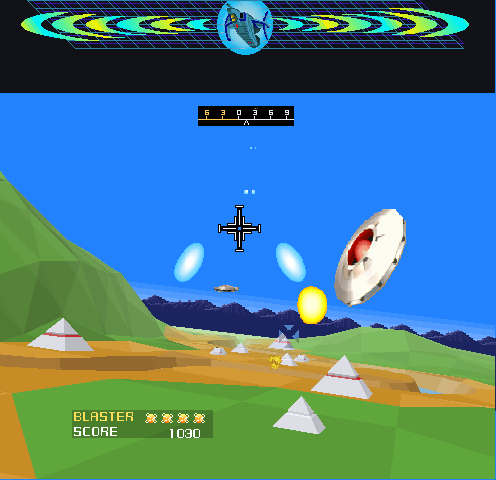
Snapshot

Game infos

Description Solvalou (Japan)
Name solvalou
Manufacturer Namco
Year 1991
Runnable yes
System arcade /
Number of players 1P
Added to MAME .062
Romset size 9.18 MB
Romset file 26 files
Romset zip 2 B
Language Japanese
Evaluation 70 to 80 (Good)
Genre Shooter

Sound infos

Sound_channels 2

Driver infos

Driver status imperfect
Driver emulation good
Driver color good
Driver sound good
Driver graphic imperfect
Driver cocktail
Driver protection
Driver savestate yes

Inputs infos

Input service yes
Input tilt no
Input players 1
Input buttons
Input coins 2

Controls infos

type ways minimum maximum sensitivity keydelta reverse
stick 96 159 20 10 no

Display infos

type rotate flipx width height refresh pixclock htotal hbend hbstart vtotal vbend vbstart
raster 0 no 496 480 60.606061 24576000 768 0 496 528 0 480

Dipswitchs

Roms list

console name bios size crc md5 merge sha1 region offset status optional
arcade c67.bin 8192 6bd8988e c9ec18d5f88d53976b94444eedc64d5568155958 dspslave 0 good no
arcade sv1-data-l.bin 524288 495fb8dd 813d1da4109652008d72b3bdb03032efc5c0c2d5 data 1 good no
arcade sv1-data-u.bin 524288 2e561996 982158481e5649f21d5c2816fdc80cb725ed1419 data 0 good no
arcade sv1-mp-l.bin 131072 28c54c42 32fcca2eb4bb8ba8c2587b03d3cf59f072f7fac5 maincpu 1 good no
arcade sv1-mp-u.bin 131072 b6f92762 d177328b3da2ab0580e101478142bc8c373d6140 maincpu 0 good no
arcade sv1-obj0.bin 524288 773798bb 51ab76c95030bab834f1a74ae677b2f0afc18c52 gfx1 0 good no
arcade sv1-obj1.bin 524288 a36d9e79 928d9995e97ee7509e23e6cc64f5e7bfb5c02d42 gfx1 100000 good no
arcade sv1-obj2.bin 524288 c8672b8a 8da037b27d2c2b178aab202781f162371458f788 gfx1 200000 good no
arcade sv1-obj3.bin 524288 293ef1c5 f677883bfec16bbaeb0a01ac565d0e6cac679174 gfx1 300000 good no
arcade sv1-obj4.bin 524288 33a008a7 4959a0ac24ad64f1367e2d8d63d39a0273c60f3e gfx1 80000 good no
arcade sv1-obj5.bin 524288 31551245 385452ea4830c466263ad5241313ac850dfef756 gfx1 180000 good no
arcade sv1-obj6.bin 524288 fe319530 8f7e46c8f0b86c7515f6d763b795ce07d11c77bc gfx1 280000 good no
arcade sv1-obj7.bin 524288 95ed6dcb 931706ce3fea630823ce0c79febec5eec0cc623d gfx1 380000 good no
arcade sv1-pt0-h.bin 524288 3be21115 c9f30353c1216f64199f87cd34e787efd728e739 point24 1 good no
arcade sv1-pt0-l.bin 524288 6a4dddff 9ed182d21d328c6a684ee6658a9dfcf3f3dd8646 point24 3 good no
arcade sv1-pt0-u.bin 524288 4aacfc42 f0e179e057183b41744ca429764f44306f0ce9bf point24 2 good no
arcade sv1-snd0.bin 131072 5e007864 94da2d51544c6127056beaa251353038646da15f audiocpu c000 good no
arcade sv1-sp-l.bin 131072 7acab679 764297c9601be99dbbffb75bbc6fe4a40ea38529 slave 1 good no
arcade sv1-sp-u.bin 131072 ebd4bf82 67946360d680a675abcb3c131bac0502b2455573 slave 0 good no
arcade sv1-voi0.bin 524288 7f61bbcf b3b7e66e24d9cb16ebd139237c1e51f5d60c1585 c140 0 good no
arcade sv1-voi1.bin 524288 c732e66c 14e75dd9bea4055f85eb2bcbf69cf6695a3f7ec4 c140 80000 good no
arcade sv1-voi2.bin 524288 51076298 ec52c9ae3029118f3ea3732948d6de28f5fba561 c140 100000 good no
arcade sv1-voi3.bin 524288 33085ff3 0a30b91618c250a5e7bd896a8ceeb3d16da178a9 c140 180000 good no
arcade sys2c65c.bin 32768 a5b2a4ff 068bdfcc71a5e83706e8b23330691973c1c214dc mcu 8000 good no
arcade sys2mcpu.bin 8192 a342a97e 2c420d34dba21e409bf78ddca710fc7de65a6642 mcu 0 good no

Chips list

name tag type clock
C140 c140 audio 21390
HD63705 mcu cpu 2048000
M68000 slave cpu 12288000
M6809 audiocpu cpu 3072000
Speaker rspeaker audio
TMS32025 dspslave cpu 96000000
YM2151 ymsnd audio 3579580

Serie

Serie : Xevious
  1. Battles (set 1) (1982)
  2. Xevios (1982)
  3. Xevious (Namco) (1982)
  4. Xevious (Atari, harder) (1982)
  5. Xevious (Atari) (1982)
  6. Xevious (Atari, Namco PCB) (1982)
  7. Xevious (Prototype 19830802) (1983)
  8. Xevious (clean crack) (1983)
  9. Super Xevious (1984)
  10. Super Xevious (Japan) (1984)
  11. Xevious (Prototype) (1984)
  12. Xevious (PAL) (1984)
  13. Xevious (1984)
  14. Xevious (1985)
  15. Xevious (1985)
  16. Xevious (Alt) (1985)
  17. Vs. Super Xevious (1986)
  18. Super Xevious - Gump no Nazo (Jpn) (1986)
  19. Super Xevious (1986)
  20. Xevious (UK) (1986)
  21. Xevious (1987)
  22. Xevious - Fardraut Saga (Jpn) (1989)
  23. Xevious (Euro) (1989)
  24. Xevious - Fardraut Saga (Jpn, Alt) (1989)
  25. Xevious (198?)
  26. Xevious (1990)
  27. Xevious (1990)
  28. Xevious - Fardraut Densetsu (1990)
  29. Xevious (Tourvision PCE bootleg) (1990)
  30. The Micro Xevious (Kor) (1990)
  31. Solvalou (Japan) (1991)
  32. Xevious 3D/G (Japan, XV31/VER.A) (1995)
  33. Xevious - Fardraut Saga (Jpn) (19??)
  34. Xevious (19??)
  35. Xevious (19??)
  36. Xevious - Fardraut Saga (Jpn, Alt) (19??)
  37. Xevious (Alt) (19??)
  38. Xevious (CCE) (19??)

Categories

MAMEinfo

0.62 [Phil Stroffolino]

0.55 [Testdriver]


Bugs:

- Solvalou crashes during the first level. Smitdogg (ID 02085)


WIP:

- 0.120u1: Phil Stroffolino fixed lockups in Solvalou and sprite priority (see mountain range).

- 0.119u1: Phil Stroffolino fixed Solvalou - Game now playable. Changed TMS32025 CPU6 clock speed to 96MHz. Added 2x c76.rom's to cpu5 and 6. Fixed rom names.

- 9th September 2007: Phil Stroffolino - Surprisingly, this was one of the first titles I'd gotten "working" with HLE years ago, but the most annoying game to get running with proper emulation. It's got the usual cuskey protection. But it also does some strange things that no other game does: 1) 68k writes a good value to shared RAM, then a NOP, then overwrites with a bad value. The master DSP is in a tight loop and has to catch the good value to proceed, forcing a game-specific cpu-yielding hack to be used by the emulator. 2) there's a block of diagnostics information written as plain text to shared RAM, things like "ROM CRC:" - this info is quite useful while stepping through the CPUs - the CPUs even emit state changes as each subsystem boots up. For some strange reason, the ascii labels (written by the master 68k) are stored much closer together in Solvalou than in any of the other multi-dsp games - the parameters written by the BIOS overwrite the explanatory text, making the diagnostics barely readable. At first I'd worried that this game used a different BIOS, but all functionality appears to be intact. 3) The master 68k doesn't stick to the "standard" bootstrap sequence, but instead triggers the BIOS to reboot itself and waits for a second checksum on the PointROMs. I've patched this out until I can definitively sort out the interrupt handling. On the plus side, Solvalou exposes some cool features not used in other games, such as the ability to place sprites with a z-order providing excellent control over mixing into the 3D scene. One big mystery I'm hoping we'll get solved soon: there are multiple palettes for the 3D objects. In some games, they are all exact copies of each others. In others, one or more will have a radically different color scheme, i.e. everything with a fiery reddish tinge. There's got to be per-polygon control registers outside the point ROMs affecting this - but would be much easier if I knew where these special palette effects were actually used in-game. Possible related: some of the point ROM objects don't actually encode 3D data, and are currently skipped to avoid parse-related crashes. These surely have some_ meaning, but nothing is obviously wrong if I ignore them.

- 0.97u1: Phil Stroffolino updated the Namco System 21 driver. Solvalou works, but occasionally 3D graphics stop updating; press "A" to unblock the pipeline and resume drawing them. It also needs cuskey support (used from the master DSP).

- 0.62: Phil Stroffolino added 'Solvalou (Japan)' (Namco 1991).

- 24th August 2002: Phil Stroffolino submitted the Namco System 21 and 22 drivers. Starblade and Solvalou are playable though missing some background graphics, the rest suffer from various problems.

- 23rd August 2002: Phil Stroffolino reported some progress with the Namco System 21 driver, which supports Starblade, Air Combat, Cyber Sled and Solvalou. All games have full sound support thanks to R. Belmont. Starblade is fully playable, but the other games are preliminary and suffer from various graphics glitches and lack of input ports.

- 0.55: Added (Testdriver) Solvalou. Locks up on startup.


LEVELS: 3


Other Emulators:

* Mjolnir


Recommended Games (Terra Force 3D):

Solvalou

Xevious 3D/G

Ray Storm

Soukyugurentai / Terra Diver

Hyperdrive

Radiant Silvergun

Ray Crisis

Star Soldier: Vanishing Earth

Vapor TRX

X Tom 3D

Brave Blade

Ikaruga

Night Raid

Psyvariar 2 - The Will To Fabricate

Trizeal

Trigger Heart Exelica

Shooting Love 2007

History


Arcade Video game published 28 years ago:

Solvalou (c) 1991 Namco.

A great sequel, with a first-person 3-D viewpoint.

You be once again the pilot of mighty combat aircraft 'Solvalou' this time under a first-person view, through the perspective of the pilot and armed with the classic weaponry the forward-firing gun for aerial targets, and the bombs to destroying ground-based targets.

Your pilot skills will be tested! destroy's all the air and ground enemies and dodge all his attacks, to reach the end and destroy the giant mothership 'Andor Genesis' to restore peace in the planet.

- TECHNICAL -

Namco System 21 hardware
Game ID : SV

Main CPU : (2x) Motorola 68000 (@ 12.288 Mhz), M6809 (@ 3.072 Mhz), HD63705 (@ 2.048 Mhz), (2x) TMS32025 (@ 24 Mhz)
Sound Chips : C140 (@ 32 Khz), YM2151 (@ 3.57958 Mhz)

Players : 1
Control : stick
Buttons : 4

- TRIVIA -

Solvalou was released in December 1991 in Japan.

Victor Entertainment released a limited-edition soundtrack album for this game (Namco Video Game Graffiti Vol.8 - VICL-8074) on April 21, 1993.

- SERIES -

1. Xevious (1982, Arcade)
2. Super Xevious (1984, Arcade)
3. Vs. Super Xevious - Ganpu no Nazo (1986, Arcade)
4. Solvalou (1991, Arcade)
5. Xevious 3D/G (1995, Arcade)
6. Xevious Arrangement (1995, Arcade): part of "Namco Classics Collection Vol.1"
7. Xevious Resurrection (2010, PS3/PSN): part of "Namco Museum.comm"

- STAFF -

Music composition by : Hiroyuki Kawada

- PORTS -

* CONSOLES:
[JP] Nintendo Wii [Virtual Console Arcade] (mar.26, 2009)

- CONTRIBUTE -

Edit this entry: https://www.arcade-history.com/?&page=detail&id=2497&o=2