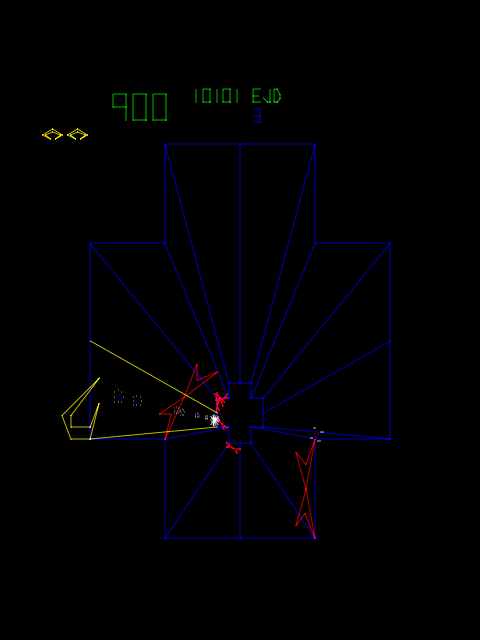
Arcade Video game published 38 years ago:
Tempest (c) 1981 Atari.
Tempest is a classic into-the-screen shoot-em-up in which the player controls a claw-shaped "Blaster" ship that moves around the outer rim of a three-dimensional, wireframe tunnel. Enemies move down the tunnel towards the player's Blaster ship and must be destroyed. Any contact with either incoming enemy fire or the enemies themselves will cost the player a life. Completion of a tunnel will see the player warp through "hyperspace" to the next tunnel to tackle a new wave of enemies.
The tunnels are each rendered in one of sixteen different geometric shapes. Enemies increase in number as the game progresses and if an enemy reaches the outer rim occupied by the player's Blaster ship, it will chase and attempt to kill the player. Rim enemies can be killed, but this is difficult to achieve.
Some enemies also drag "spikes" - in the form of lines in the middle of the corridor - behind them as they travel up the tunnel towards the player. These spikes must be avoided during the "hyperspace" warp sequence at the end of the level, as contact results in the loss of a life.
Two "SuperZappers" are available per level. The first SuperZapper kills all enemies on the playfield at the time of firing, while the second randomly kills only one enemy on the playfield. The SuperZapper does not affect enemy shots, spikes or enemies that have not yet landed on the playfield.
One new feature Tempest introduces is "Skill-Step". This allows players to start a new game on the same level as was previously reached (although the new game must be restarted within thirty seconds) without having to replay previous levels. This allows skillful players to continue being challenged, while less experienced players can try to master higher levels. The 99 skill levels of play includes sixteen different playfields and seven different enemy targets.
* The tubes are divided into cosmic corridors through which the aliens travel, although some aliens such as Pulsars and Flippers can move from one corridor to the next. Regardless of the tube shapes, aliens always begin their invasion from the small, distant end of the tube. The sixteen unique tube shapes are as follows :
1. Circle
2. Square
3. Plus symbol
4. Bow-tie
5. Stylized Cross
6. Triangle
7. Clover
8. V
9. Steps
10. U
11. Completely Flat
12. Heart
13. Star
14. W
15. Fan
16. Infinity Symbol (figure 8 on its side)
The playfield's color scheme changes every sixteen levels. In addition, other events also cause playfield color variation. The SuperZapper causes the playfield to flash as enemies are zapped. Playfield rails flash rainbow colors when a player earns a bonus life and Pulsar enemies cause sections of the nearest rim to disappear and - during the pulse phase - adjacent rails to flash.
Tempest level color schemes:
*Levels 1-16:
Tunnel - blue
Player ship - yellow
SuperZapper - yellow
Flippers - red
Tankers - purple
Spikers/Spikes - green
Pulsars - N/A (these do not appear until the next colour scheme)
*Levels 17-32:
Tunnel - red
Player ship - green
SuperZapper - cyan
Flippers - purple
Tankers - blue
Spikers/Spikes - cyan
Pulsars - yellow
*Levels 33-48:
Tunnel - yellow
Player ship - blue
SuperZapper - blue
Flippers - green
Tankers - cyan
Spikers/Spikes - red
Pulsars - blue
*Levels 49-64:
Tunnel - cyan
Player ship - blue
SuperZapper - red
Flippers - green
Tankers - purple
Spikers/Spikes - red
Pulsars - yellow
*Levels 65-80:
Tunnel - black (invisible)
Player ship - yellow
SuperZapper - white
Flippers - red
Tankers - purple
Spikers/Spikes - green
Pulsars - cyan
*Levels 81-96:
Tunnel - green
Player ship - red
SuperZapper - purple
Flippers - yellow
Tankers - purple
Spikers/Spikes - blue
Pulsars - yellow
Levels 97 and up - Keeps color scheme from Levels 81-96, with random shapes from Level 99 onward.
- TECHNICAL -
[Upright model]
Game ID : 136002
Main CPU : MOS Technology M6502
Co-processor : Math Box
Sound Chips : (2x) POKEY
Tempest has a color X-Y or vector-generator monitor. This new monitor, with its 3-color guns and higher voltage, has the same technology that was used in Atari's black-and-white X-Y monitors. However, this new monitor displays dazzling color and unique visual effects in a spectacular 3-D video display.
Players : 2
Control : dial
Buttons : 2
= > (1) Fire, (2) Super Zapper
- TRIVIA -
Tempest was released in October 1981 at the price of $2,295. 25,113 Upright units were produced. Tempest sold approximately 20,000 units to distributors before it was even released.
Tempest was an awesome arcade game that transported the player into abstract realms of space. It is still the favorite of devotees who seek to become one with this adventure through hyperspace.
Tempest was the first game to use 'Color-Quadrascan' and 'Skill-Step', both features unique to Atari vector games. Tempest was originally a 3-D "Space Invaders" clone called 'Vortex', but was changed when the other engineers didn't come back to play the game. This was kind of a test for an Atari game; if the engineers kept coming back to play a new game, it was considered a hit.
The first prototype of the game had the shape wireframe spinning and the gunner remaining stationary, but that caused motion sickness after a period of time so it was changed around.
* The Creation of Tempest : Dave Theurer, who designed the game and wrote the software, said his original intention was to make a first-person perspective of the "Space Invaders" game, but he ended up doing something completely new and different.
Rich Adam : "Dave implemented a first-person "Space Invaders". Everybody played it but they didn't keep coming back. You could tell when you had something cool, the engineers kept coming back. This was good and bad because there were times when you wanted to work on your game and everybody would want to be playing it. But when he was doing the first-person "Space Invaders", Dave didn't run into this problem of everyone wanting to play the game...and he said to himself : 'Well, maybe this isn't working. What can I do?' Then I came in one day and all of a sudden he had this round tube with these things coming up it. I said, 'What the heck is that Dave?' He said, 'I don't know. Aliens from the center of the Earth? I don't know.' I think he said something about having had a dream about it. I said, 'How does it work?' He said, 'I don't know. They're coming up around the edge of this thing and you're trying to blow them away.' He just sort of started out with this concept and took it from there. I can see why he would say that Tempest was certainly his proudest achievement. He worked extremely hard on that. It's pure creation from his own brain.".
* Remembrances from the Video Game Masters : Although known for his hard work and for his ability to focus on and conquer exceedingly tough software problems, Dave Theurer looks back upon his days at Atari as having been fun and rewarding.
Dave Theurer : "It was just so exciting working on these new games. All my life I loved explosions. When I went to college I was a chemistry major because I wanted to do something where I could make explosions. When I was a kid I had a chemistry set and I'd blow stuff up all the time. Eventually, you learn that you can't really do that in real life, so the next best thing is to do it on the screen, so here I was blowing stuff up on the screen. Simulating real life is fun too. It's almost like you can create your own universe. Well, you are creating your own universe. That's rewarding, to see something come alive.".
Playing games, both video and pinball, was a constant part of life for the engineers at Atari.
Dan Pliskin : "In the morning, I used to go in and I'd make up a pot of Italian roast or French roast coffee and pour myself a big mug. Then I'd go and sit it on a pinball machine and drink coffee and play pinball until scores got up to, like, a couple hundred thousand. That would be my indication that I was sharp enough to go and design something.".
* Popular from the Start : Tempest was a game that immediately captivated people from the very start.
Lyle Rains : "Like a number of these games that were very addictive, the Tempest controls were good enough to where once you learned how to manipulate them you could almost become one with the machine. That is, a good Tempest player gets to spin that knob and do the firing in the right time and get into sync with the machine or get into a rhythm. I don't know exactly what to call it, but you were so close to the action that part of you entered the experience. You forgot about what was going on around you and you were just there. And you could get very good at it. I think what people like is the ability to accomplish amazing things".
* The Great 25-Cent Escape : Not only did players often find a sense of welcome escape in the video games they played, but this was very much the intention of some of the great game designers.
Dave Theurer : "I want to design it for a guy who's totally frazzled by his job and needs a way to temporarily escape. There's a certain class of games...where you just get into a trance when you're playing them. As long as you're in this trance you'll do fine."
The default high score screen of "Cyberball 2072" features names of many Atari arcade games, including TEMPEST.
A Tempest unit appears in the 1982 movie 'Fast Times at Ridgemont High', in the 1983 movie 'Twilight Zone - The Movie', in the 1983 movie 'Joysticks', in the 1984 movie 'Night of the Comet', in the 1986 movie 'Running Scared', in the 1986 movie 'Maximum Overdrive' (A cocktail cabinet) and in the 1987 movie 'Death Wish 4 - The Crackdown'.
A Tempest unit appears in the music video 'Subdivisions' by RUSH.
In 1982, Atari released a set of 12 collector pins including : "Missile Command", "Battle Zone", "Tempest", "Asteroids Deluxe", "Space Duel", "Centipede", "Gravitar", "Dig Dug", "Kangaroo", "Xevious", "Millipede" and "Food Fight".
- UPDATES -
Revision 1 :
* First public release.
Revision 2 :
* Fixes the score cheat in test mode.
* Changes spinner letters to a line.
Revision 3 :
* Fixes screen collapse between 1 and 2 players in the 2-player mode.
- SCORING -
Spike : 1-3 points
Spiker : 50 points
Tanker : 100 points
Flipper : 150 points
Pulsar : 200 points
Fuseball : 250, 500, or 750 points (The closer it is to your Blaster when you shoot it, the more points you get.
In addition to the above points, you also get bonus points for starting at higher levels then Level 1. Listed are the bonus points for all starting levels. There is no real pattern except that the bonus gets higher the more levels you skip at your starting point.
Level 3 : 6,000 points
Level 5 : 16,000 points
Level 7 : 32,000 points
Level 9 : 54,000 points
Level 11 : 74,000 points
Level 13 : 94,000 points
Level 15 : 114,000 points
Level 17 : 134,000 points
Level 20 : 152,000 points
Level 22 : 170,000 points
Level 24 : 188,000 points
Level 26 : 208,000 points
Level 28 : 226,000 points
Level 31 : 248,000 points
Level 33 : 266,000 points
Level 36 : 300,000 points
Level 40 : 340,000 points
Level 44 : 382,000 points
Level 47 : 415,000 points
Level 49 : 439,000 points
Level 52 : 472,000 points
Level 56 : 531,000 points
Level 60 : 581,000 points
Level 63 : 624,000 points
Level 65 : 656,000 points
Level 73 : 766,000 points
Level 81 : 898,000 points
NOTE: The bonus points are rewarded only once per game, when you complete your starting level.
At the beginning of the game, you can always start on levels 1, 3, 5, 7, or 9. Whenever you complete a game, you have either ten seconds or until you press a key to continue a game. You can start a game at any bonus level below where you finished your last game. Therefore you must end your previous game on level 12 or higher to start your next game on level 11.
If you fail to clear the starting level you have chosen, that level is not available for you in the next game. However, all starting levels below it are available. For instance, if you start a game on level 17 but do not finish, then your next game can start as high as level 15.
- TIPS AND TRICKS -
* Hints :
- Continue playing until you destroy all aliens or until all the aliens reach the rim of your universe. If you have a Blaster, you advance to the next level of play.
- Players should work their way up through the levels to become familiar with game play. Drop down a level if play is too difficult.
- Experienced players should start at highest level possible for maximum points.
- On a new playfield shoot at enemy dots at far rim.
- Try to shoot aliens while they are still in the corridors of the cosmic tube. They pose a greater threat (and are harder to hit) once they reach the rim of your universe.
- Shoot a Flipper as soon as it starts to flip. Anticipate where they are heading and fire your Blaster in that direction.
- Once a Flipper reaches the rim, you can shoot it only by waiting for it to flip into initial contact with your Blaster. But you must fire before it takes the next step and flips on top of your Blaster.
- Tankers carry other aliens. To destroy their cargo, move your Blaster back and forth across adjacent corridors as you fire.
- Fuseballs spend most of their time along the edges of the corridors, out of firing range. To make sure you hit them, move your Blaster from one side of a corridor to the other while you fire. Once they reach the rim, you can only destroy them with your SuperZapper.
- Use long Spikes to reclaim shots and kill enemies approaching you from adjacent lanes.
- Avoid shooting Fuseball Tankers near the top since emerging fuseballs usually zip up to the top and kill you.
- When Pulsars contract into a zigzag bolt of lightning, quickly move your Blaster away from their corridor.
- Fire at Pulsars after they fire, but before they get ready to fire again. Pulsars and Fuseballs are like Flippers in their ability to switch corridors.
- Watch for corridors that are open along the rim. You can still move your Blaster over the gaps, but beware...there is a Pulsar inside.
- Don't fire at missiles. They are dangerous and you don't get points for destroying them.
- Avoid spikes. At the end of a level, position your Blaster over a corridor that is free from spikes. During higher levels of play, blast away at the Spikers and their spikes to keep a safe corridor for your next hyperspace passage. Remember, you can't destroy them with just one shot.
- Use the SuperZapper right before last enemy reaches the top for a few extra points.
* 898,000 points bonus :
1) You must have the Revision 1 ROMs in your machine.
2) You must have your machine set to coins and not on free-play.
3) Start a game and play until you successfully clear Level 24 (red V). Die.
4) Start a new game on the Level 24 and complete the stage to get a bonus taking your score to more than 160,000.
5) As soon as you get the bonus from clearing Level 24, get the last two digits of your score to 46 (by shooting spikes). Die.
6) Wait! Wait for one cycle of the machine's attract mode - high score initials, TEMPEST attract, game demonstration, high score table.
7) Start a new game, spin the spinner to the right all the way up to Level 81 (green circle).
8) Complete the stage for a bonus of 898,000.
* These are cheats. (They weren't cheats at all. They were intentionally programmed in as a security measure.) They were removed in ROM 217 and 222 software revision 2. First, you must complete Level 8 (blue V) and get a score with the format XXYYZZ : XX must be greater than 16, YY between 29 and 60, ZZ is a code listed below...
00 - freeze screen
01 - access bookkeeping totals
05 - allows playing during attract mode
06 - 40 free credits
11 - 40 free credits
12 - 40 free credits
14 - credit sound without actual credit
15 - credit sound without actual credit
16 - 40 free credits
17 - 40 free credits
18 - 40 free credits
41 - switch last 2 digits of score
42 - increase score quickly
46 - demonstration mode - start at any level, up to level 81
50 - player moves by itself
51 - player moves by itself
60 - objects drift down
66 - objects drift right
67 - objects jump
68 - objects drift up
70 - objects drift up
After code '05' (play during attract mode) is activated, the following cheats become available...
Set the last two digits to 46 : Random-colored level with wrong enemies.
Set the last two digits to 48 : 255 extra lives.
These are tips for anyone new to Tempest :
Note : Level colors mentioned below refer to the level's tunnel color.
1) Flippers first appear in Level 1 (blue circle), but don't start flipping until Level 2 (blue square). Flippers flip at a constant rate, so play the angles. You can kill Flippers on the outer edge by shooting when they are in the spaces next to you (as they flip). The wider the angle, the more time you have to shoot. You can also move under Flippers as they flip. Good practice is to play Level 1 as long as possible without firing. On the open shapes, you will want to hang out on one end of the other (to avoid attacks from both directions). On closed shapes, pick a spot with good angles and good visibility. Often flipping back and forth between two spaces (playing the angles depending on which direction the flippers are attacking from) is all you have to do.
2) Tankers first appear in Level 3 (blue plus). Regular Tankers contain two Flippers. Feel free to shoot them and their cargo with impunity. Fuseball tankers are VERY dangerous. Shoot them and get out of the way. Pulsar tankers are also very dangerous. Shoot them and stay where you are (the Pulsars will appear to either side). You can differentiate between the types of tankers by looking closely at their centers. Fuseball and Pulsar Tankers have tiny pictures of their cargos in their centers. The ability to instantly differentiate between tanker types is probably the most important ability separating good Tempest players from great Tempest players.
3) Spikers first appear in Level 4 (blue bowtie). Spikers are generally harmless (although they do shoot at you), and the spikes they lay down are very handy some times. You can hold the fire button down for continuous fire, but you only get a maximum of eight shots at a time. This is enough to fill half the tube, but not enough for a true continuous stream of shots. If you have lots of flippers coming after you, find a long spike to sit on top of. You can then hold down the fire button for a machine gun effect. As the spike gets eaten away, look for another one to switch to. Be careful of pulsars and fuseballs when you do this however. When you get to level 65 (black/invisible circle) try riding a full spike all the way down at the end of the round. Your descent rate and rate of fire are perfectly matched so that you can actually blast it away without being impaled all the way to the bottom.
4) Fuseballs first appear in Level 11 (blue flat/bowling alley). Fuseballs ride the lines. The safest place to be is in the space NEXT to one. It looks like it will kill you, but the hit logic only tests the center of the fuseball. Fuseballs will only cross one space at a time before dropping back down (until the end of the round when they start chasing you). If you get stuck with one coming after you at the end of a round (usually on one of the open shapes), try the 'Hail Mary' move of spinning very quickly. You can actually jump over one or more spaces (and a fuseball!) if you spin fast enough. Watch out for fuseball tankers at higher levels that split into two fuseballs that will immediately try and jump on you.
5) Pulsars first appear in Level 17 (red circle). Pulsars are only dangerous when they are pulsing. Listen to the low, periodic buzz sound. As you get used to it, you will find yourself adapting to this built-in rhythm. You can shoot them when they aren't pulsing or spin out of the way. Watch out for pulsar tankers at higher levels that split into two pulsars on either side of the tanker lane.
6) Dip Switch #2 (2nd from the back of the game) on the upper bank (at N13) controls demo mode. Demo mode lets you start (and practice) anywhere you like. It does not record scores, however. In normal play, the game will let you start close to where you left off. If you want to 'cheat', put the game into demo mode, spin up to where you want to start, start the game and hit the 1P Start button causing you to zoom down the tube and gain the bonus. Then die and flip the dip switch back to normal mode. Now you can start a real game at the same level and record your score at the end. If you do this often, wiring a front-mounted bypass to that dip switch will come in very handy. There is also a freeze game dip switch that is also handy in case the phone rings while you are playing.
7) Level 81 (green circle) is the highest starting level. Most expert Tempest players agree that green is actually easier than the black/invisible levels that precede it. It is a bit faster, but it restores one of the most valuable visual clues in the game - the tell tale break in the outer edge caused by a pulsar (which is missing in the black/invisible levels). After level 96 (green figure eight/infinity), you are back to the green circle (97) and green square (98). Level 99 is the highest recorded by the game and consists of a never ending supply of random green shapes. Every time you finish the round or lose a life, you will end up with a different shape. To achieve a world record score, you will spend MOST of your time playing level 99 over and over again. If you can keep your rate of loss to roughly one life per two rounds (at 20K bonus), you can theoretically play forever. Tempest isn't a very good marathon game, however, as it only lets you build up 5 lives max at any one time. A 30-second bladder break while playing level 99 will pretty much wipe you out.
8) The highest score recordable by the game is 999,999 (a horrible error on the part of the designers). Starting at Level 81, you get there pretty fast (mid way through the greens). With a bit of practice, you can end the game at exactly 999,999. Do that 3 times and no one will ever be able to beat your score on a single machine (w/o clearing the high score table).
- SERIES -
1. Tempest [Upright model] (1981, ARC)
2. Tempest 2000 [Model J9010E] (1994, JAG)
3. Tempest X3 [Model SLUS-00283] (1996, PSX)
4. Tempest 3000 (2000, NUON)
- STAFF -
Designed and programmed by : Dave Theurer (DFT)
Project leader : Morgan Hoff (MPH)
Hardware Guy : (SDL)
Math Box : Jed Margolin
Technician : (MJP)
From highscore table : Erik Durfey (EJD), Dave Shepperd (DES), (RRR), (BEH)
- PORTS -
* CONSOLES:
[US] Atari 2600 "Tempest [Model CX2687]" : Proto, Only one cart exists by the looks of it :)
[US] Atari 5200 "Tempest [Model CX5220]" : Unreleased prototype
[US] Sony PlayStation (dec.31, 1996) "Arcade's Greatest Hits - The Atari Collection 1 [Model SLUS-00339]"
[EU] Sega Saturn (1997) "Arcade's Greatest Hits - The Atari Collection 1 [Model T-25413H-50]"
[US] Sega Saturn (june.30, 1997) "Arcade's Greatest Hits - The Atari Collection 1 [Model T-9706H]"
[US] Nintendo SNES (aug.1997) "Arcade's Greatest Hits - The Atari Collection 1 [Model SNS-AW7E-USA]"
[EU] Sony PlayStation (dec.1997) "Arcade's Greatest Hits - The Atari Collection 1 [Model SLES-00466]"
[EU] Nintendo SNES (feb.26, 1998) "Arcade's Greatest Hits - The Atari Collection 1 [Model SNSP-AW7P-EUR]"
[US] Sony PlayStation (2001) "Atari Anniversary Edition Redux [Model SLUS-01427]"
[US] Sega Dreamcast (jul.2, 2001) "Atari Anniversary Edition [Model T-15130N]"
[EU] Sony PlayStation (mar.1, 2002) "Atari Anniversary Edition Redux [Model SLES-03808]"
[US] Microsoft XBOX (nov.16, 2004) "Atari Anthology [Model 26084]"
[US] Sony PS2 (nov.22, 2004) "Atari Anthology [Model SLUS-21076]"
[EU] Microsoft XBOX (nov.26, 2004) "Atari Anthology"
[EU] Sony PS2 (feb.18, 2005) "Atari Anthology [Model SLES-53061]"
[JP] Microsoft XBOX (aug.4, 2005) "Atari Anthology [Model B7X-00001]"
Microsoft XBOX 360 [XBLA] (2007)
[US] Sony PlayStation 4 (oct.18, 2016) "Atari Flashback Classics Vol.1"
[US] [EU] Microsoft XBOX One (nov.1, 2016) "Atari Flashback Classics Vol.1"
* HANDHELDS:
[US] Nintendo GBA (mar.25, 2002) "Atari Anniversary Advance [Model AGB-AAVE-USA]"
[EU] Nintendo GBA (feb.14, 2003) "Atari Anniversary Advance [Model AGB-AAVP-EUR]"
[UK] Nintendo DS (mar.11, 2005) "Retro Atari Classics [Model NTR-ATAE-UKV]"
[EU] Nintendo DS (mar.11, 2005) "Retro Atari Classics [Model NTR-ATAE-EUR]"
[US] Nintendo DS (mar.16, 2005) "Retro Atari Classics [Model NTR-ATAE-USA]"
[JP] Nintendo DS (june.30, 2005) "Atarimix Happy 10 Games [Model NTR-ATAJ-JPN]"
[AU] Nintendo DS (nov.2007) "Retro Atari Classics [Model NTR-ATAE-AUS]"
[US] Sony PSP (dec.19, 2007) "Atari Classics Evolved [Model ULUS-10325]"
[AU] Sony PSP (mar.7, 2008) "Atari Classics Evolved"
[US] Nintendo DS (nov.2, 2010) "Atari Greatest Hits Vol.1 [Model NTR-BR6E-USA]"
[EU] Nintendo DS (feb.24, 2011) "Atari Greatest Hits Vol.1 [Model NTR-BR6P-EUR]"
* COMPUTERS:
[US] Apple II (1983) "Tubeway"
[EU] Acorn Electron (1985)
[EU] Amstrad CPC (1986)
[EU] Atari ST (1989)
[EU] Commodore C64 "Genesis"
[EU] Sinclair ZX Spectrum
PC [MS Windows 3.1x, 3.5"] [US] (1993) "Microsoft Arcade"
[EU] PC [MS Windows, CD-ROM] (1999) "Atari Arcade Hits 1"
[US] PC [MS Windows, CD-ROM] (jul.13, 1999) "Atari Arcade Hits 1"
[US] PC [MS Windows, CD-ROM] (jul.9, 2001) "Atari Anniversary Edition"
[EU] PC [MS Windows, CD-ROM] (dec.14, 2001) "Atari Anniversary Edition"
[US] PC [MS Windows, CD-ROM] (nov.11, 2003) "Atari - 80 Classic Games in One! [Model 25069J]"
[EU] PC [MS Windows, CD-ROM] (june.10, 2005) "Atari - 80 Classic Games in One! [Replay]"
[US] Steam (mar.24, 2016) "Atari Vault [Model 400020]"
* OTHERS:
[US] Nokia N-Gage (feb.2006) "Atari Masterpieces Vol. II"
[EU] Nokia N-Gage (mar.30, 2006) "Atari Masterpieces Vol. II"
Apple Store (2011) "Atari Greatest Hits"
Android Market (2011) "Atari Greatest Hits"
- CONTRIBUTE -
Edit this entry: https://www.arcade-history.com/?&page=detail&id=2865&o=2