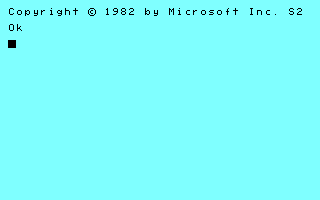
Computer published 36 years ago:
Aquarius (c) 1983 Mattel Electronics.
- TECHNICAL -
CPU: Zilog Z-80, 3.5 MHz
Memory: 4K RAM, expandable to 20K RAM; 8K ROM
Keyboard: 48-key rubber chiclet
Display: 40x24 text, 80x72 graphics, 16 colors
Sound: One voice, expandable to four voices
Ports: Television, cartridge/expansion, tape recorder, printer
Hardware Sprites: None
PSU: Hard-wired into case and cannot be removed.
- TRIVIA -
Looking to compete in the standalone computer market, Mattel Electronics turned to Radofin, the Hong Kong based manufacturer of their Intellivision consoles. Radofin had designed two computer systems. Internally they were known as Checkers, and the more sophisticated Chess. Mattel contracted for these to become the Aquarius and Aquarius II, respectively. Aquarius was announced in 1982 and finally released in June 1983, at a price of $160. Production ceased four months later because of poor sales. Mattel paid Radofin to take back the marketing rights, and four other companies—CEZAR Industries, CRIMAC Inc., New Era Incentives, Inc., and Bentley Industries—also marketed the unit and accessories for it. Bentley Industries (of Los Angeles) and New Era Incentives, Inc. (of St. Paul) are still in business, though they no longer have any affiliation with the Aquarius product line.
The Aquarius often came bundled with the Mini-Expander peripheral, which added gamepads, an additional cartridge port for memory expansion, and the GI AY-3-8914 sound chip, which was the same one used on the Intellivision console. Other common peripherals were the Data recorder, 40 column thermal printer, 4K and 16K ram carts. Less common first party peripherals include a 300 baud cartridge modem, 32k RAM cart, 4 color plotter, and Quick Disk drive.
Although less expensive than the Texas Instruments TI-99/4A and Commodore VIC-20, the Aquarius had comparatively weak graphics and limited memory—internally, Mattel programmers dubbed it the system for the seventies. Of the 32 software titles Mattel announced for the unit, only 21 were released. Most of the released titles were ports from Mattel's Intellivision game console, but because the Aquarius lacked programmable graphics, the gameplay of many games was better on the less-expensive console. Contrastingly, computer offerings from other companies who sold both computers and consoles, such as Atari and Coleco, commonly matched and sometimes exceeded the capabilities of their consoles.
Shortly after the release of the Aquarius, Mattel announced plans for another home computer, the Aquarius II. There is evidence that the Aquarius II reached the market in small numbers, but it was never a commercial success.
- CONTRIBUTE -
Edit this entry: https://www.arcade-history.com/?&page=detail&id=34772&o=2