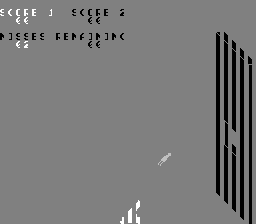
0.83 [Stefan Jokisch]
WIP:
- 0.162: Osso added save state support to Cannonball.
- 0.147u4: Zerofill missing tile rom (right 4 tile pixels are empty now instead of random) [hap].
- 0.135u2: Fabio Priuli added driver data structs to Cannonball.
- 7th June 2004: MASH - Completed the missing gfx rom with the characters and numbers roms from Canyon Bomber and Sky Diver (Atari 1977/8). The cannon and gun gfx-halfs are guess work.
- 0.83: Stefan Jokisch added 'Cannonball (Atari, prototype)' (Atari 1976). One ROM is missing from the only known PCB causing some GFX problems. The author mentions one only test unit.
- 3rd June 2004: Stefan Jokisch sent in a driver for Cannonball (Atari, prototype), but it's missing a graphics ROM, causing some graphics glitches.
STORY:
- Owen Rubin (first Atari coin-op game programmer) - Cannonball game story: I have been asked about the very first game I worked on at Atari and how my first creation took place. That would be the coin-op version of Cannon Ball. The game was one of the very early microprocessor games created at Atari in early 1976. I liked playing the game Stunt Cycle, a hardware only game where you jumped a motorcycle over an ever increasing array of busses, and wanted something that easy with increasing difficulty. At that time, video games were almost completely created by four people: The hardware engineer, the software engineer, the mechanical designer (cabinet and controls) and a tech. There were some support people to the hardware engineer for building prototypes, and the software engineers had computer operators, but I did not even know about them at this time. The entire game, graphics and sound were created by the software engineer for the most part. I received a very basic motion object hardware (Black, White, and Grey objects) with a simple bitmap stamp playfield and told to create a game. I had not been at Atari long, so I had no idea HOW a game was built, just that there were a few people there doing it. I was amongst the first 5 programmers so we sort of made it up as we went along. Ok, so they set me up in a small lab next to my small office, and I got to work. First, I created the graphics for a small man running, flying through the air, and hitting the wall, including a "squish" animation, and a man walking off holding his back. This was all done in 8x8 motion objects, several put together to make a bigger object. So on graph paper, I created these objects. I was no artist, but it was easy at that resolution. I then did the same thing to create the cannon, the wall with a hole in it, a powder keg, and a smoke blast! These I hand programmed into a small PROM (this was before EEPROM), so you wanted to be sure you did it right. After I got the graphics installed, I sat down at a device called MicBug, a 6800 (NOT 68000) Motorola "development" system. This was a small computer board that had a cable that plugged into the processor socket of the game board with some RAM, You entered instructions at a model 33 teletype! With this device you could put in a breakpoint, alter memory and registers, run and stop the processor. Very basic. So, with a small card with 6800 instructions on it, I began writing AND HAND ASSEMBLING my code on paper, then I would type it into the model 33 teletype into MicBug, and save it on paper tape. Editing was done by creating small "patch" paper tapes with changes. I had a big box of changes, and would eventually punch out a full dump. After a number of months, my boss suggested a review of the game. No problem. We set it up. I had the game running, simple sounds, self test, and all coin routines. I would guess about 75% of the project. A man came out, stood next to the cannon and waited.
On the opposite side of the screen was a tall wall with a hole in it (that moved each round) Pulling on the handle caused the powder keg to add powder to the cannon. The more powder, the higher the shot. Releasing, the man jumped into the cannon. Push the fire button and the man flew out of the cannon towards the hole. Make it through and you scored. Miss, and you splat into the wall or floor and limped off. Simple but fun. Towards the end of the review, my boss asked if he could see my program code listings. Listings? What listings did he mean? Well, as it turns out, there was a way to create programs for games, I just never knew about it. Rather than hand assembling, one simply wrote the program on paper, handed it to a computer operator who then edited it into an early DEC PDP computer (like an 05 for example.). These operators would assemble the program and produce a paper tape output and a listing of the assembled program. Oh! Then the program remained on the PDP. Later changes were simply scrawled across the listings and edited by the same two people into the PDP, and a new listing and paper tape was created. What took me months I probably could have done in half that time. Oh well, so much for the easy way. But since I was so far along, inputting this into the PDPs was going to be a long process. But a Model-33 teletype listings, lots of pen scrawls and I was "up-to-date". Now the fun began. They wanted more sounds, and most of all, a sound when the man hit the wall. So I set out to create a bone crunching, splat sound. But how? All we had was a modulated white noise generator. So we took a microphone and a recording scope into the bathroom, and began throwing wet towels onto the tile floor and recorded the waveform. I programmed this into the noise generator and there it was. Every time the man hit the wall, SPLAT! It was great. But the game was still too silent. What about music? Not with this hardware, this was long before games could generate music. So we added an Eight Track Tape unit on a relay and licensed some circus music, so every time the game started, you heard the looping circus music. The game operators where we tested this unit hated that after several weeks, but the game actually did fairly well. The kicker to this story was that during a later review, management said they hated the splat sound and thought it was too graphic. Several months later I started my next project, Sky Diver. Knowing they hated the splat from Cannonball, I decided to have the divers over water and splash into the water if they did not open their shoots. First review, two managers said "... remember that sound in Cannonball when the man hit the wall? Can we have that sound here instead of the splash? Let the man hit the ground and splat!" Of course, I made it comical, but that is how the splat came about in Sky Diver, which is another story.
Recommended Games (Circus):
Cannonball
Circus
Clowns
Dead Eye
Gypsy Juggler
Space Walk
Kick
Manhattan (DECO Cassette)
Wall Street
Circus Charlie
Konami 80's AC Special (Circus Charlie)
Cycle Maabou
Plump Pop
Jumping Pop (Nics, Korean hack of Plump Pop)
Angel Kids
Crazzy Clownz
Jump Jump
Arcade Video game published 43 years ago:
Cannonball (c) 1976 Atari.
- TECHNICAL -
Main CPU : M6800 (@ 756 Khz)
Screen orientation : Horizontal
Video resolution : 256 x 224 pixels
Screen refresh : 60.00 Hz
Palette Colors : 6
Players : 1
Buttons : 2
- TRIVIA -
Cannonball was Owen Rubin's first game at Atari. It is not known for sure if this game was ever produced, as there is no documentation or flyers of the game that have surfaced. Owen Rubin seems to think that maybe it WAS produced; however, he is unsure.
Owen wrote Cannonball while sitting in his small office at a Model 33 teletype connected to a Motorola MicBug 6800 processor, both of which were connected to simple videogame hardware. He hand-assembled the entire program--it was only 2K, but still took several months--including self-test, saving the code on punched paper tape. When his boss reviewed the game and asked for code listings, Owen said, 'What listings?' It turns out that Owen didn't know about the two computer operators, who took the listings that the designers/programmers wrote up, typed them into the PDP-1 computers, ran them to make sure they were error-free, then return a paper tape to the designer.
- STAFF -
Designed & Programmed by : Owen Rubin
- PORTS -
* CONSOLES:
Atari 2600 (Human Cannonball)
- CONTRIBUTE -
Edit this entry: https://www.arcade-history.com/?&page=detail&id=3468&o=2