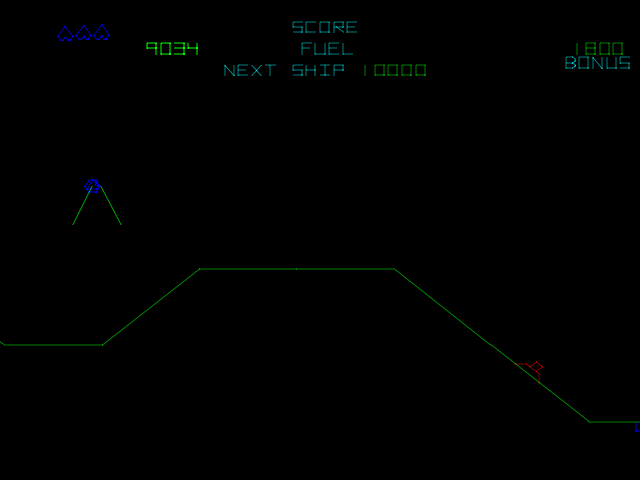
Arcade Video game published 37 years ago:
Gravitar (c) 1982 Atari.
Gravitar is a 1- or 2-player game with a color X-Y video display. This new display, with its three color guns and higher voltage, has the same technology that was used in previous Atari black-and-white X-Y displays. However, the screen now displays dazzling colors and unique visual effects.
The player controls a space ship in three different solar systems. Each solar system consists of a home base, a death star, a red alien planet and four regular planets. Each planet has its own unique terrain.
The red alien planet is the home of shooting alien ships. Some of the regular planets may have flying alien rammers to be avoided or shot down. The four planets all have fuel cells to be retrieved with a tractor beam and alien bunkers that fire shells. Successfully destroying all of the bunkers results in a 'MISSION COMPLETE' message at the top of the screen. Achieving 'MISSION COMPLETE' allows the player to collect bonus if he can evade the rammers when leaving the planet. If successful, he will be placed back in the solar system.
A player has two ways to advance to the next solar system. The first is to successfully complete a mission on all four regular planets. The second way is to complete a mission on the red alien planet, which establishes a link into the next solar system.
The play mode begins in the first solar system with the player's blue ship in the center of the screen at home base. There are four regular planets plus a fifth red alien planet and a death star arranged clockwise around the screen in increasing order of difficulty. The planets are worth 2,000, 4,000, 6,000, and 8,000 points with a value of 9,000 points on the alien planet. The positions of the alien planet and the death star vary in the second and third solar systems. After the first solar system all planets are valued at 9,000 points. The death star, located near home base, is the center of gravity in each solar system. Colliding with it results in the loss of one life, and the player returns to home base.
The words 'SCORE' (with current total score), 'FUEL' (running total of original 10,000-point fuel supply), and 'BONUS' (decreasing point value of planet under attack) appear at the top of the screen throughout game play.
Player controls consist of LEFT ROTATE, RIGHT ROTATE, FIRE, THRUST, and TRACTOR/SHIELD yellow pushbuttons. Use FIRE to shoot targets. A player has four shells that must hit a target or must travel their full distance in order to be reloaded. TRACTOR/SHIELD retrieves fuel with a tractor beam and shields the ship from alien shots. The TRACTOR/SHIELD does not prevent the ship from crashing into land or alien ships. TRACTOR/SHIELD and THRUST decrease the player's fuel supply. Using these controls together decreases the fuel supply even faster.
Blue fuel cells are positioned just below a planet's surface. There are two, three, or four fuel cells per planet terrain (depending on level of game play). Each cell beamed aboard ship with TRACTOR is worth 2,500 fuel units.
If the player's ship is above the highest point on some planet terrains, flying alien rammers attack him. Shooting a rammer scores 100 points.
If the player gets too close to a shooting alien ship, he is involved in a one-on-one space dogfight, and either he or the alien ship must die. If the player is victorious, he returns to the solar system at his original spot; if the alien ship wins, the player loses a life and returns to home base.
Red alien bunkers appear on each planet. There are 2, 4, 6, or 8 bunkers per surface (depending on the difficulty of the planet). The bunkers fire shots to protect the fuel cells. Exploding a bunker scores 250 points. Exploding all bunkers in a solar system displays a 'MISSION COMPLETE' message.
The word 'SUPERBONUS' and the number of superbonus points appear in the middle of the screen only after a completed mission on the first planet in the first solar system. These superbonus points are awarded on the basis of initial difficulty of the first planet successfully completed. The higher the bonus point value of the planet attacked, the higher the superbonus awarded. No superbonus points are awarded for attacking the 2,000-point (easiest) planet or for attacking the four regular planets in consecutive order of difficulty.
A player may fly to any planet he chooses. The number beside each planet is the starting number of bonus points for that planet. Entering a planet causes the distinct planet terrain to appear. To get maximum points, the player must shoot all alien bunkers and see 'MISSION COMPLETE' at the top of the screen. A player may exit a planet at any time; he does not have to stay any longer than he wishes.
The red alien planet (worth 9,000 points) is home for red alien ships that must be shot down or avoided. The alien planet looks the same in every solar system: terrain consists of a spiral tunnel with a reactor at its end. Under a decrementing timer, the player must maneuver through the tunnel without hitting the walls and shoot the reactor (Hitting the walls or not escaping in time places the player back at home base). Shooting the reactor will make it glow and pulsate. Then the player must escape before the timer reaches zero (In the next solar systems, the timer of the alien planet decreases by two seconds, and there are shooting bunkers to overcome). Completing the mission on the alien planet places the player in the next solar system with an additional 7,500 fuel points.
Gravitar progresses by waves of planets (new solar systems). Successfully destroying the reactor and escaping from the red alien planet, or achieving a MISSION COMPLETE on all four regular planets places the player in the next solar system (next level of game play). The 4 levels of game play are described as follows :
a. Regular gravity
b. Negative gravity
c. Regular gravity with invisible landscape and maximum difficulty
d. Negative gravity with invisible landscape and maximum difficulty
Alien ship speed and firing frequency, rammer speed, bunker firing frequency, and bonus points are all based on time elapsed in game play. Both regular and negative gravity increase, depending on the initial planet bonus level.
The game ends when all lives are used up or when player is out of fuel.
- TECHNICAL -
Game ID : 136010
Main CPU : MOS Technology M6502 (@ 1.512 Mhz)
Sound Chips : (2x) POKEY (@ 1.512 Mhz)
Screen orientation : Horizontal
Vector display (1024x768)
Players : 2
Buttons : 5 (LEFT ROTATE, RIGHT ROTATE, FIRE, THRUST, TRACTOR/SHIELD)
- TRIVIA -
Gravitar was released in August 1982.
5,427 units were produced and original selling price was $2,095.
Developed in 14 months, Gravitar was the first game that Mike Hally produced and designed for Atari. The concept of Gravitar was based on a combination of "Lunar Lander" and "Asteroids".
Gravitar has a color X-Y video display. This display, with its three color guns and higher voltage, has the same technology that was used in previous Atari black-and-white X-Y displays. However, the screen now displays dazzling colors and unique visual effects.
Gravitar was the first game to have a real-time dynamic perspective - When you enter a planet, the screen zooms in to give you a closer look. Unfortunately, it was a colossal failure, primarily because of its difficulty. While beautiful to look at for its time, the learning curve was too steep too early - When you're plugging quarters into a machine, you stop playing a tough game. But interest in the title has resurged among hard-core arcade gamers. This is because once the controls are mastered, the game is phenomenally addictive.
On the other hand, saying it's "phenomenally addictive" under whatever condition is a highly subjective and, let's face it, completely unsubstantiated statement, especially in light of the game's disastrous performance in the actual marketplace. People loved hard games in the days, like Defender. This game was simply a poorly conceived piece of eye candy, an example of tech and former laurels taking the place of cohesive planning and testing.
The default high score screen of "Cyberball 2072" features names of many Atari arcade games, including GRAVITAR.
Dan Coogan, of Phoenix, AZ set a new Gravitar world record, scoring 8,029,450 points on December 23, 2006, playing for 23 hours and 15 minutes. The previous world record was 4,722,200, which reigned for 24 years, set by Ray Mueller of Boulder, CO on December 4, 1982, playing for 12 hours and 21 minutes.
A Gravitar unit appears in the 1983 movie 'WarGames', in the 1983 movie 'James Bond 007 - Never Say Never Again' and in the 1987 movie 'Death Wish 4 - The Crackdown'.
In 1982, Atari released a set of 12 collector pins including : "Missile Command", "Battle Zone", "Tempest", "Asteroids Deluxe", "Space Duel", "Centipede", Gravitar, "Dig Dug", "Kangaroo", "Xevious", "Millipede" and "Food Fight".
The prototype of this game is known as "Lunar Battle".
- SCORING -
Obstacles :
Red bunker : 250 points
Rammer : 100 points
Alien Ship : 100 points
Each planet has a bonus that constantly decreases with elapsed game time.
A superbonus is awarded after the first 'MISSION COMPLETE' is achieved.
Planet Bonus 9,000 - Superbonus 20,000
Planet Bonus 8,000 - Superbonus 12,000
Planet Bonus 6,000 - Superbonus 6,000
Planet Bonus 4,000 - Superbonus 2,000
Planet Bonus 2,000 - Superbonus 0
- TIPS AND TRICKS -
* Depending on the highest score, 1 of 8 list names appears above the table of initials...
Between 0 and 20,000 points : FLUNKY
Between 20,001 and 40,000 points : GUNNER
Between 40,001 and 80,000 points : CO-PILOT
Between 80,001 and 100,000 points : PILOT
Between 100,001 and 200,000 points : ACE PILOT
Between 201,001 and 400,000 points : KILLER PILOT
Between 400,001 and 800,000 points : PONTIUS PILATE
Above 800,000 points : GOTTA-BE-LUCKY
* A Well Known Cheat/Bug : At a joint between 2 vectors (>90 degrees), position yourself below and shoot straight up. If you can align yourself just right, the shots will travel through the walls at the joint. Without moving from side to side, just thrust up and voila, you are now inside the wall. You can now move around and shoot the gun pods from behind. This is especially useful if you can get under the world!
* Hint 1 : Develop skill for controlling the space ship in regular and negative gravity.
* Hint 2 : Beam up fuel cells with TRACTOR/SHIELD.
* Hint 3 : Attack the red alien planet first for maximum challenge and 20,000 bonus points! Completion of this planet immediately places a player in the next solar system where all planets are worth 9,000 bonus points.
* Hint 4 : Attack more difficult planets early in the game for higher bonus points.
* Hint 5 : Many planet terrains have safe areas or 'blind spots' from which the player can safely shoot at bunkers.
- STAFF -
Designed by : Mike Hally (MLH)
Programmed by : Rich Adam (RDA)
Tech & hardware designer : Joe Coddington (JOE)
Others : Owen Rubin (ORR), Mark Cerny (MEC), Brad Chaboya (BRD)
- PORTS -
* CONSOLES:
[US] Atari 2600 (1983) "Gravitar [Model CX2685]"
[US] Atari 2600 (1988) "Gravitar"
[US] Sony PlayStation (2001) "Atari Anniversary Edition Redux [Model SLUS-01427]"
[US] Sega Dreamcast (jul.2, 2001) "Atari Anniversary Edition [Model T-15130N]"
[US] Sony PlayStation (mar.1, 2002) "Atari Anniversary Edition Redux [Model SLES-03808]"
[US] Microsoft XBOX (nov.16, 2004) "Atari Anthology [Model 26084]"
[US] Sony PS2 (nov.22, 2004) "Atari Anthology [Model SLUS-21076]"
[EU] Microsoft XBOX (nov.26, 2004) "Atari Anthology"
[EU] Sony PS2 (feb.18, 2005) "Atari Anthology [Model SLES-53061]"
[JP] Microsoft XBOX (aug.4, 2005) "Atari Anthology [Model B7X-00001]"
[US] Microsoft XBOX One (nov.1, 2016) "Atari Flashback Classics Vol.2"
[US] Sony PlayStation 4 [EU] (nov.1, 2016) "Atari Flashback Classics Vol.2"
* HANDHELDS:
[UK] Nintendo DS (mar.11, 2005) "Retro Atari Classics [Model NTR-ATAE-UKV]"
[EU] Nintendo DS (mar.11, 2005) "Retro Atari Classics [Model NTR-ATAE-EUR]"
[US] Nintendo DS (mar.16, 2005) "Retro Atari Classics [Model NTR-ATAE-USA]"
[JP] Nintendo DS (june.30, 2005) "Atarimix Happy 10 Games [Model NTR-ATAJ-JPN]"
[AU] Nintendo DS (nov.2007) "Retro Atari Classics [Model NTR-ATAE-AUS]"
[US] Nintendo DS (nov.2, 2010) "Atari Greatest Hits Vol.1 [Model NTR-BR6E-USA]"
[EU] Nintendo DS (feb.24, 2011) "Atari Greatest Hits Vol.1 [Model NTR-BR6P-EUR]"
* COMPUTERS:
[US] PC [MS Windows, CD-ROM] (apr.4, 1998) "Atari Arcade Hits 2"
[EU] PC [MS Windows, CD-ROM] (2000) "Atari Arcade Hits 2"
[US] PC [MS Windows, CD-ROM] (jul.9, 2001) "Atari Anniversary Edition"
[EU] PC [MS Windows, CD-ROM] (dec.14, 2001) "Atari Anniversary Edition"
[US] PC [MS Windows, CD-ROM] (nov.11, 2003) "Atari - 80 Classic Games in One! [Model 25069J]"
[EU] PC [MS Windows, CD-ROM] (june.10, 2005) "Atari - 80 Classic Games in One! [Replay]"
[US] Steam (mar.24, 2016) "Atari Vault [Model 400020]"
* OTHERS:
Apple Store [US] (2012) "Atari Greatest Hits"
Google Play [US] (2012) "Atari Greatest Hits"
- CONTRIBUTE -
Edit this entry: https://www.arcade-history.com/?&page=detail&id=1006&o=2