0.107 [David Haywood]
WIP:
- 0.150: Phil Bennett fixed Midnight Landing - Game now playable. DMA RAM appears to be double buffered, and the 68000s likely 8MHz. Fixes bad 'LANDING'/'COURSE OUT' text [Phil Bennett]. Added CPU board layout, based on small photo [hap]. Changed M68000 CPU1/2 clock speed to 8MHz, TMS32025 CPU5 to 32MHz, VSync to 54.112554 Hz, palettesize to 32768 colors and region unknown to adpcm2. Added 2nd MSM5205 (384000 Hz). Added dipswitches 'Coin A Enable', 'Coin B Enable', 2x 'Unused' and 'Unknown'.
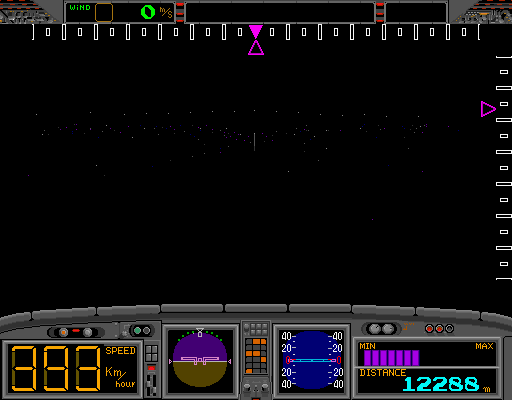
- 31st August 2013: Phil Bennett - Owing to some great work from Kale and hap, emulation of Midnight Landing had improved over time but the game could still not be classed as playable. Having recently found a video recording of the game made from actual hardware, I decided to take another look at getting it working properly. The first difference I noticed was the lack of engine sound in MAME. I surmised that the engine sound circuit was similar to that of Top Speed; an MSM5205 ADPCM chip driven by a variable clock from a Z80 CTC. Sure enough, I was right. Next, I tried to figure out why the colours were incorrect. Midnight Landing's video hardware is an unusual design by Taito standards in that it is blitter based. There's 512KB of (CPU-accessible) video RAM, enough for two 520x400x8 video buffers (medium-resolution). There's also 32kx16 of palette RAM, though only 1024 entries are actually used. The raw graphics data is 4bpp and one of the blit parameters specifies a 4-bit palette value, which gives an 8-bit index into palette RAM. This only allows for 256 colours; so how is the full range of palette RAM addressed? Well, it turns out I'd overlooked the special 'clear' mode of the blitter. Video RAM regions are cleared twice; first to clear pixel data and then to set a 7/8-bit palette index for the region. This suggests there's only one 520x400x16 buffer but given that very little needs to be redrawn per frame (the instrument panel is mostly static and the background is entirely black) and most blits can likely execute within the vertical blank period, there's no need for double buffering. The final step was to fix the analog controls. The throttle and yoke controls are read as 12-bit values, and the existing hookup appeared to have the upper nibble and lower 8-bits swapped. Once corrected, the game became playable.
- 0.148u4: 12mhz TMS DSP? I doubt that this also fixes the arrow indicator 'gfx smear' bug. "sound cpu error" should be gone now, so cleaned up some of the sound code. ADPCM improvements and some misc changes. Small update on dips. Reimplemented analog controls, but it's still about as bad as it was before [hap]. Changed TMS32025 CPU5 clock speed to 24MHz. Changed region audiocpu ($14000) to unknown ($0). Removed 8-way Joystick and all buttons. Added dipswitches 'Coin Mode', 'Demo Sounds', 'Coin A/B' and 'Difficulty'.
- 0.142u3: Angelo Salese removed deprecat.h dependancy and updated irqs accordingly for Midnight Landing.
- 0.132u3: Angelo Salese fixed sub CPU reset line, main-to-sound CPUs communications, color banking and added PORT_TOGGLE for the inputs in Midnight Landing. Fixed analog inputs. Added DSP and background graphics. Fixed ADPCM rom loading. Phil Bennett fixed foreground framebuffer graphics. Added TMS32025 (12MHz) CPU5. Added dipswitches 'Cabinet', 'Test Mode /2', 'Allow Continue', 'Language' and '$2000-0 -> 7'. Changed description to 'Midnight Landing (Germany)'.
- 27th June 2009: Angelo Salese - Me and Phil Bennett moved our efforts over Midnight Landing, the first of the Taito Landing series. The main issue was mostly the "dot writings" that are the characteristic "night drawing" of this game. After some false mis-steps (that were even close to the current status), I've discovered that this game uses the same DSP as his sequel Top Landing (the TMS32025) for calculating the dot data to be displayed. Dox also pointed out that the "dot" data in reality is stored in the gfx ram, so in the real world the main 68k feeds some raw data to the sub 68k then the sub 68k processes this data and gives it to the DSP. The DSP then does some math operations and gives this data to the sub 68k and finally the sub 68k converts the data to the proper format and gives it back to the main 68k. In short, it's (unsurprisingly) an unoptimized mess. Game has still bugs (sound cpu comunications fails sometimes, palette banking isn't yet understood) and somebody should explain to me if there's particular rules about how to play this one (inputs doesn't seem to be consistant).
- 0.132u2: Angelo Salese improved sound and inputs in Midnight Landing. Changed number of buttons and coin slots to 2. Added dipswitches 3x 'SYSTEM' and 17x 'Unknown'.
- 0.130u1: Angelo Salese fixed Midnight Landing gfx bitplanes.
- 0.130: Angelo Salese hooked up paletteram in Midnight Landing.
- 0.111u4: Many improvements to the Midnight Landing driver, including partial sound, partial video emulation and controls. Still not working, though [Tomasz Slanina]. Added 2x Z80 (4MHz) CPUs and YM2151 and MSM5205 sound. Changed visible area to 512x400. Fixed rom loading. Added Player1, 8-way Joystick, Stick and 6x buttons. Added dipswitches 'Demo Sounds', 'Flip Screen' and 'test 1'.
- 30th July 2006: Tomasz Slanina - Some progress on Midnight Landing.
- 0.107: David Haywood added 'Midnight Landing' (Taito 1990).
Recommended Games (Flying):
Sky Diver
Rip Cord
Fly-Boy
Midnight Landing
Top Landing
Landing Gear
Prop Cycle
Hang Pilot
Airline Pilots
Airline Pilots (deluxe)
Landing High Japan
Arcade Video game published 32 years ago:
Midnight Landing (c) 1987 Taito America Corp.
A 3-D flight simulator game.
- TECHNICAL -
Main CPU : (2x) Motorola 68000, (2x) Zilog Z80
Sound Chips : Yamaha YM2151, OKI MSM5205
Players : 1
Buttons : 6
- TRIVIA -
Midnight Landing was released in May 1987. It represents the very first flight simulator in Japan!
In 1986, a prototype version was location tested.
The game designers wanted to have a background at noonday but this was canceled because technical problems happened.
8 years after this game, the famous sound team, zuntata, remaked the main music of this game in "Landing Gear".
Soundtrack releases :
Kyukyoku Tiger - G.S.M. Taito 2 [Pony Canyon / Scitron - D28B0008 - 1988.11.21]
- TIPS AND TRICKS -
* You can't get perfect score because game programmers omitted to program the 100 points feature at each stage...
- SERIES -
1. Midnight Landing (1987)
2. Top Landing (1988)
3. Landing Gear (1995)
4. Landing High Japan (1998)
5. Jet De GO! (2000, Sega Dreamcast)
6. Jet De GO! (2002, Sony PlayStation 2)
7. Jet De GO! Pocket (2005, Sony PSP)
- STAFF -
Composer : Shizuo Aizawa (Zuntata)
- CONTRIBUTE -
Edit this entry: https://www.arcade-history.com/?&page=detail&id=4614&o=2