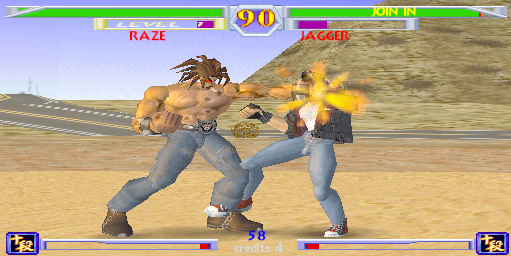
0.91u1 [Aaron Giles]
HardDisk required
WIP:
- 0.119u4: Changed description to 'Tenth Degree (prototype)'.
- 0.102u5: Aaron Giles fixed subtle bug in the MIPS3 recompiler that prevented Tenth Degree from working.
- 21st December 2005: Aaron Giles - Figure out why Tenth Degree no longer worked. It used to, and I was sure it was due to the Voodoo rewrite. I spent quite a bit of time looking into that, assuming I was returning an incorrect value from the status register or something. Turns out I was completely wrong. Instead, an "optimization" I had made to the MIPS dynarec core a while back had a subtle side effect. The problem was literally with the particular opcode: slti r2,r3,$1. In the old dynarec core, that was translated as: mov eax,[r3.lo]; mov edx,[r3.hi]; sub eax,1; sbb edx,0; shr edx,31; mov [r2.hi],0 and mov [r2.lo],edx. The optimization I added was to convert code that subtracted 1 from a register to use the dec opcode instead, since it is more compact. So the new code was: mov eax,[r3.lo]; mov edx,[r3.hi]; dec eax; sbb edx,0; shr edx,31; mov [r2.hi],0 and mov [r2.lo],edx. Which is 4 bytes smaller, taking up less instruction/trace cache space. Multiply this over a lot of generated code and it has an impact. The problem is that dec eax is not quite the same as sub eax,1. Specifically, dec does not set the carry flag, meaning that the sbb instruction that followed would never "borrow" from the high word, messing up the math. So with that, Tenth Degree is working again, and better than ever. One thing I discovered in my recent research is that if certain values (red, green, blue, alpha, Z, and W) overflow during triangle rasterization, they are allowed to wrap in a slightly odd fashion. For example, if the red component increases from $FF to $100 to $101 over the course of several pixels, you would expect it to wrap from $FF to $00 to $01. But the internal microcode in the Voodoo actually checks explicitly for $100 and clamps it to $FF, while allowing $101 to wrap to $01. So what you actually get is a transition from $FF to $FF to $01. Why is this important? Well, let's say you are drawing a triangle such that the leftmost pixel has a red value of 0.0 and the rightmost pixel has a red value of 1.0. Converting these values to integers between 0-255 means the left value is $00 and the right value is $100. If the Voodoo allowed simple wrapping, that last pixel would be drawn as $00, showing up as an ugly black pixel right next to a bright red one. The simple clamping logic allows for a bit of slop of 1 on either the high or low side without producing artifacts. The upshot is that if you run an old build of MAME and look at Tenth Degree, you'll see lots of artifacts - unsightly black or white pixels that shouldn't be there. Implementing this clamping logic turns out to fix these problems. Mace: The Dark Age also suffered from the same problem to a lesser degree. I bet the Tenth Degree engine was based off of the Mace engine.
- 0.91u1: Aaron Giles added 'Tenth Degree' (Atari 1998).
Recommended Games (Asian Fighting 3D):
Mortal Kombat
Mortal Kombat II
Mortal Kombat 3
Mortal Kombat 3 (bootleg of Megadrive version)
Mortal Kombat 3 (SNES bootleg)
Ultimate Mortal Kombat 3
Mortal Kombat 4
Virtua Fighter
Virtua Fighter 2
Virtua Fighter 3
Virtua Fighter 4
Virtua Fighter 4 Evolution
Virtua Fighter 4 Final Tuned
Virtua Fighter 5
Virtua Fighter Kids
Virtua Fighter Remix
Tekken
Tekken 2
Tekken 3
Tekken 4
Tekken 5 Dark Resurrection
Tekken 5.1
Tekken Tag Tournament
Battle Arena Toshinden 2
Jackie Chan - The Kung-Fu Master
Jackie Chan in Fists of Fire
Street Fighter: The Movie
Street Fighter EX
Street Fighter EX Plus
Street Fighter EX2
Street Fighter EX2 Plus
Dead or Alive
Dead Or Alive ++
Dead or Alive 2 Millennium
Heaven's Gate
Ragnagard
Soul Edge
Soul Calibur
Soul Calibur II
Soul Calibur III
Star Gladiator Episode I: Final Crusade
Plasma Sword: Nightmare of Bilstein
Fighters' Impact A
Fighting Bujutsu
Battle Tryst
Fighting Layer
Samurai Shodown 64
Samurai Shodown: Warrior's Rage
Tenth Degree
Power Stone
Power Stone 2
The Battle of Yu Yu Hakusho
Fate: Unlimited Codes
Harddisk: 3.01 GB (CYLS: 392, HEADS: 255, SECS: 63 - Compressed: 735.8)
Arcade Video game published 21 years ago:
Tenth Degree (c) 1998 Atari Games Corporation.
Atari's Tenth Degree was to combine the elements of the Tekken and Street Fighter style fighting games with an emphasis on speed. Videogames.com got a chance to see Tenth Degree in its early stages, and even played a few rounds on the arcade machine. The characters were designed in a 3D anime style, with both male and female fighters available. In the early stages, developers were discussing having a super deform mode and some other surprises as well. The characters would have had a variety of fighting styles.
- TECHNICAL -
Runs on the "Atari Vegas" hardware.
Players : 2
Control : 8-way Joystick
Buttons : 6
- TRIVIA -
Tenth Degree (originally to be called "Juko Threat") was to be Atari's apparently failed attempt to join the great 3-D fighter genre. Unfortunately for Atari by 1998 Namco had released "Tekken 3" and "Soul Calibur" and Sega were onto "Virtua Fighter 3" and "Fighting Vipers 2", meaning that unless a 3D fighter really stood out it wasn't going to make an impact at all... It was dropped from production as it just didn't take any money during testing, it had nothing that hadn't been seen before, and the competition was just too advanced by the time it would reach full production.
- STAFF -
Game Director: James Goddard (DJames.)
Lead Combat Designer: James Goddard (DJames.)
- CONTRIBUTE -
Edit this entry: https://www.arcade-history.com/?&page=detail&id=3780&o=2