Manufacturers

Loading

Turret Tower

  1. Game infos
  2. Sound
  3. Driver
  4. Inputs
  5. Controls
  6. Display
  7. Roms list
  8. Chips list
  9. Disks list
  10. Categories
  11. MAMEinfo
  12. History
Download turrett.zip (2 MB)
Snapshot

Game infos

Description Turret Tower
Name turrett
Manufacturer Dell Electronics (Namco license)
Year 2001
Runnable yes
System arcade /
Number of players 1P
Added to MAME .132u4
Romset size 2 MB
Romset file 4 files
Romset zip 354 B
Language English
Genre Shooter

Sound infos

Sound_channels 2

Driver infos

Driver status good
Driver emulation good
Driver color good
Driver sound good
Driver graphic good
Driver cocktail
Driver protection
Driver savestate yes

Inputs infos

Input service yes
Input tilt no
Input players 1
Input buttons
Input coins 2

Controls infos

type ways minimum maximum sensitivity keydelta reverse
stick 32 31 60 2 no

Display infos

type rotate flipx width height refresh pixclock htotal hbend hbstart vtotal vbend vbstart
raster 0 no 336 244 30.164093 4000000 512 0 336 259 0 244

Roms list

console name bios size crc md5 merge sha1 region offset status optional
arcade turret.u12 524288 a2a498fc 47f2c9c9f2496b49fd923acb400166e963095e1d maincpu 1 good no
arcade turret.u13 524288 85287007 990b954905c66340d3e88918b2f8cc7f1b9c7cf4 maincpu 0 good no
arcade turret.u7 524288 fa8b5a5a 658e9eeadc9c70185973470565d562c76f4fcdd7 maincpu 3 good no
arcade turret.u8 524288 ddff4898 a8f859a0dcab8ec83fbfe255d58b3e644933b923 maincpu 2 good no

Chips list

name tag type clock
R3041 maincpu cpu 25000000
Speaker rspeaker audio
Turret Tower Sound ttsound audio 25000000

Disks list

name md5 sha1 merge region index status optional
turrett b0c98c5876870dd8b3e37a38fe35846c9e011df4 ata:0:hdd:image 0 baddump no

Categories

MAMEinfo

0.132u4 [Siftware]


HardDisk required


Setup:

- After loading Bank-A and B a 'INSPECTION REQUIRED' pops up. Press Service (F2), insert coins and press P1 Start (1) to start the game.


WIP:

- 0.151: Philip Bennett and smf fixed Turret Tower - Game now playable. Marked the Turret Tower CHD as bad. Note: According to http://personal.inet.fi/cool/lwgt/myoldvdr/V40ProductManual.pdf. The drive should have CYLS:38869, HEADS:16, SECS:63, Total Units:39,179,952. We are missing 13482 sectors and we have to adjust the LBA by 63 sectors for the game to work [smf]. Added 'Turret Tower Sound' (25MHz) and left/right Speakers. Changed visible area to 336x244, palettesize to 32768 colors and VSync to 30.164093 Hz. Added Player 1, Stick, 7x buttons and 2x coin slots.

- 26th October 2013: smf's ongoing refactor of the ATA/IDE code finally allowed cleanly adding Phil Bennett's long-awaited support for Turret Tower. Here are a few screens - it plays OK with a Xbox 360 pad to do the analog steering.

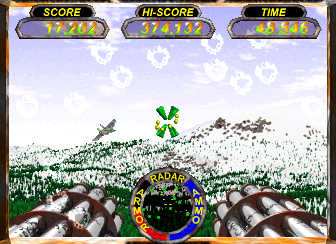
- 12th January 2013: Phil Bennett - Turret Tower (Dell Electronics) puts you in the seat of an anti-aircraft turret and throws fighter jets at you from all directions. The aim is simple; destroy everything. A cargo plane drops power-ups, ammo and armour replenishments to prolong your fight. The graphics are big and the sound is loud. 'Manic' pretty much sums it all up. The main attraction of the game was its motion cabinet, which rotates the seat and monitor through 360 degrees as the joystick is moved. In its absence the game is still fairly fun to play. The hardware is an interesting fully-custom design from a time where PC-based arcade hardware was becoming prevalent. The board itself is very compact, consisting of a 25MHz MIPS R3000, a pair of Xilinx FPGAs and two 128MB SIMMs. Graphics and sound are stored on a 20GB IDE HDD (of which only ~4.5GB is used). A DMA engine is implemented within the FPGAs which can transfer graphics data between the HDD, RAM and VRAM. Objects residing in RAM are RLE-compressed and may be down-scaled when transferred to VRAM. Additive, subtractive and multiplicative colour blending modes are supported and the hardware also implements a rudimentary hit-detection scheme. Lastly, sound is provided by a 32-channel DMA engine mixing 16-bit samples at 44.1KHz. Some hardware details did have me stumped for a while. Take colour blending for example. The MSB of the 16-bit source pixel data specifies framebuffer blending. The additive blending mode (used for snow, rain and bullet holes) is enabled by a video control register (of which only two bits actually have an effect) but the subtractive and multiplicative modes are selected by the state of the pixel's green and blue component LSBs! Bizarre as it seems, this hack allows sprites with different blend modes to be drawn in a single operation (such as explosions). Many sprites also have multiplicative blending enabled on their edge pixels to achieve an anti-aliasing effect. Inputs are driven by individual interrupts, which took a while to get working correctly. I've yet to figure out how the outputs for the seat motor work. All in all, a rather interesting game to emulate!

- 0.132u4: Siftware added 'Turret Tower' (Dell Electronics (Namco license) 2001).


Recommended Games (Antiaircraft):

Anti-Aircraft

Bazooka

Desert Patrol

Guided Missile

M-79 Ambush

Missile-X

Attack Force

Sky Chuter

Tora Tora

Red Alert

D-Day

Commando (Sega)

Ozon I

Field Combat

Danger Zone

Guts n' Glory (Antiaircraft)

Turret Tower


Harddisk: 18.7 GB (CYLS: 2438, HEADS: 255, SECS: 63 - Compressed: 1.55)

History


Arcade Video game published 18 years ago:

Turret Tower (c) 2001 NAMCO.

Turret Tower is a one-player gunner/fighter pilot action game. The game components are housed in a compact 6. 5 in., octagon shaped cabinet. "Turret Tower" is a uniquely designed attraction.

Turret Tower drops the player into an exciting war-bird environment. The player assumes the role of a gunner in a turret and also controls the direction of the aircraft. He sits in a swiveling gun turret and has the option of six wicked weapons to destroy his enemies. Two of the weapons, the mini-gun and grenade launcher are available at the onset of the game, plus the player gets to choose one of the four "super" weapons. Two of the "super" weapons are not available until the player reaches a specific level. The player chooses from one of three levels, each varying in difficulty. A "bonus" level is awarded to those players who successfully complete the first three. Each of the four levels are comprised of three waves of attack.
The playing console, seat and monitor can rotate right or left a full 360 degrees! The player controls this motion using the joystick. A variety of power-ups are awarded to those players with the best homing and firing techniques. The power-ups are released by shooting parachutes during the game play.

Turret Tower does not require an attendant due to the multiple safety features incorporated into the game design. These features include a door lock and seat belt, the deadbolt door lock must be in the locked position and the player must have the seat belt fastened in order for the game to operate. The floor mat will detect if there is more than one person inside the game or if the player is trying to stand up. If either of these conditions are detected the game will automatically stop operating.

- STAFF -

Developed by Dell Electronics.

Designed and engineered by George Dell, who handled the mechanical side of things, and Brian Weber, who handled the graphics, sound and game design, it took the 2 of them 4 years from conceiving the project to its release.

- CONTRIBUTE -

Edit this entry: https://www.arcade-history.com/?&page=detail&id=22878&o=2