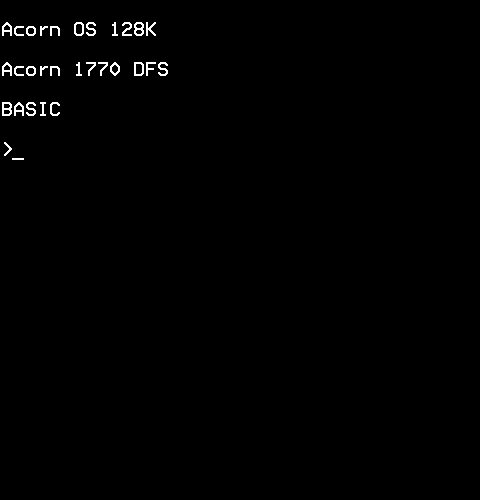
Computer published 38 years ago:
BBC Micro (c) 1981 Acorn Computer, Limited.
- TRIVIA -
During the early 1980s, the BBC started what became known as the BBC Computer Literacy Project. The project was initiated partly in response to an extremely influential ITV documentary series The Mighty Micro, in which Dr Christopher Evans of the UK's National Physical Laboratory predicted the coming microcomputer revolution and its effect on the economy, industry, and lifestyle of the UK.
The BBC wanted to base its project on a microcomputer capable of performing various tasks which they could then demonstrate in their 1982 TV series The Computer Programme. The list of topics included programming, graphics, sound and music, teletext, controlling external hardware and artificial intelligence. It decided to adopt a microcomputer brand, then developed a fairly ambitious (for its time) specification and asked for takers. The BBC discussed the requirement with several companies including Sinclair Research, Newbury Laboratories, Dragon Data and Acorn Computers.
The Acorn team had already been working on an upgrade to their existing Atom microcomputer. Known as the Proton, it included better graphics and a faster 2 MHz MOS Technology 6502 central processing unit. The machine was only at the design stage at the time, and the Acorn team, composed largely of students including Steve Furber and Sophie Wilson, had one week to build a working prototype from the sketched designs. The team worked through the night to get a working Proton together to show the BBC. Not only was the Acorn Proton the only machine to match the BBC's specification, it also exceeded it in nearly every parameter.
The machine was released as the BBC Microcomputer on 1 December 1981 and became known affectionately as the Beeb. The machine was popular in the UK, especially in the educational market: about 80 per cent of British schools had a BBC microcomputer. As with Sinclair's ZX Spectrum and Commodore's C64, both released later in 1982, demand greatly exceeded supply. For some months, there were long delays before customers received the machines they had ordered. Efforts were made to market the machine in the United States and Germany.
By October 1983, the US operation reported that American schools had placed orders with it totalling $21 million.
In October 1984, while preparing a major expansion of its US dealer network, Acorn claimed sales of 85 per cent of the computers in British schools, and delivery of 40,000 machines per month.
That December, Acorn stated its intention to become the market leader in US educational computing. The New York Times considered the inclusion of local area networking to be of prime importance to teachers. The operation resulted in advertisements by at least one dealer in Interface Age magazine, but ultimately the attempt failed. The success of the machine in the UK was due largely to its acceptance as an educational computer – UK schools used BBC Micros to teach computer literacy, information technology skills and a generation of games programmers. Acorn became more known for its model B computer than for its other products. Some Commonwealth countries, including India, started their own Computer Literacy programs around 1987 and used the BBC Micro, a clone of which was produced by the Semiconductor Complex Limited and named the SCL Unicorn.
An advantage for the BBC Micro in the educational market was its durable construction. Both casing and keyboard were built solidly and able to cope with abuse by schoolchildren.
The Model A and the Model B were priced initially at £235 and £335 respectively, but increasing almost immediately to £299 and £399 due to increased costs. Acorn anticipated the total sales to be around 12,000 units, but eventually more than 1.5 million BBC Micros were sold.
The cost of the BBC Models was high compared to competitors such as the ZX Spectrum and the C64, and from 1983 Acorn attempted to counter this by producing a simplified but largely compatible version intended for game playing, the 32K Acorn Electron.
- CONTRIBUTE -
Edit this entry: https://www.arcade-history.com/?&page=detail&id=34777&o=2