Arcade Video game published 39 years ago:
Moon Cresta (c) 1980 Nichibutsu
Moon Cresta is a single screen shoot-em-up with the player controlling an armed ship that moves horizontally along the bottom of the screen and must use their ship to destroy waves of attacking aliens.
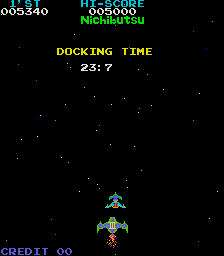
The player begins the game with a small ship armed with a single laser cannon. Upon successful completion of the first four waves of alien attacks, the player's ship will be able to dock with the next 'stage' of fighter ship, although the docking procedure must be completed within a set time. This larger, two-stage ship has increased fire power (three lasers).
After successfully clearing a further two alien waves and surviving a meteor shower, the two-stage ship will be able to dock with the third and final piece, giving the player the largest and most powerful ship, which is now armed with five lasers. Bonus points are awarded depending on how quickly the docking procedures are completed.
If the multi-stage ship is hit, the player continues with whatever stages remain. If players achieve a score of 30,000, they are awarded a free game and their score continues to accumulate.
Upon completion of the first eight screens, the player's ship will revert back to its small, single-stage incarnation and the game begins again with an increased level of difficulty.
- TECHNICAL -
Model MCA-5001 (Upright)
Main CPU : Zilog Z80 (@ 3.072 Mhz)
Sound Chips : Tone generator & discrete circuits
Players : 2
Control : 2-way joystick (RIGHT and LEFT)
Buttons : 1 (FIRE/THRUST)
- TRIVIA -
Moon Cresta was released in July 1980.
Marcus McHaffie holds the official record for this game with 153,490 points.
- SCORING -
Scoring in this game is relatively simple. Each alien (except meteors and arrows) come in two different colors for each screen.
Eyes (Break in half) : 50 points
Eyes (Destroy other half) : 100 points
Flies : 30 points
Birds : 60 points
Fireballs : 200 points
Arrow Ships : 100 points
Docking is a big way to increase your score. You get the time remaining from 30 seconds multiplied by 100 for your docking bonus.
- TIPS AND TRICKS -
* When you start the game, all three stages of your ship will come from the bottom of the screen. After going halfway up, the ship on top separates from the other 2 and it settles onto the bottom of the screen ready for battle.
* Remember, you can only keep one set of shots in the 'air' at one time. This means you need to plan your shots out so you don't end up with a lot of misses when the aliens decided to come after your ship.
* In the later screens, the aliens start moving much quicker and you have to be on your toes to keep up with them and avoid being taken out.
* Although the aliens do not fire, they still can cause a lot of hate and discontent by their wild maneuvering. There is no real safe place on the screen from the aliens since they go into the lower corners of the screen, reappear from the bottom after they have apparently 'left' the screen, or just appear right above your ship.
* In the earlier waves, you have to split apart 2 eyes before the rest automatically split and come after your ship. In the later screens, the eyes automatically split upon entering the screen. That means eight instead of four aliens you have to deal with.
* If you manage to dock all three ships together, you will have a lot of firepower (5 shots at once) to send out. Here are some ways, unfortunately, you can lose ships and what ships are lost :
1) Besides the aliens, docking is the second way people lose a lot of ships. The only ship destroyed is the ship attempting to dock.
2) If an alien hits any part of your ships (if all stages are joined), only the stage hit is lost. This can create an amusing circumstance if you lose stage II and you only have stages I and III to fight with.
* Don't worry if you lose Stage I early in the game. One has to be very skilled to fight four screens with Stage I. Stage II is the best stage to fight with. It is a small target plus it has enough firepower to defend itself. Stage III on the other hand, is just a lumbering junkyard. The lasers are too spread out to do much good plus there is a very wide-open area in the middle for aliens to hit.
* The bird stages present the most challenge of the aliens. They appear and disappear at will. Sometimes they will appear right next to your ship so on these stages, be extra alert. If you see one disappear and don't hear the familiar bird chirp of it reappearing, assume it is on the screen somewhere still.
* The best place to 'hide' during the fireball stage is in the lower right corner. The fireballs will not hit your ship in this corner. You can do hit and runs by moving your ship out, shooting at a fireball, then going back to the corner again.
* During the arrow screen, the aliens will hover around the top, then turn into arrows and attempt to ram your ship. In the later screens, they won't even hover but just try to ram your ship.
* Your goal is to make it to 30,000 points so you can have a fresh ship waiting in case you lose all the stages of your present ship.
* Docking isn't that hard to do. After finishing off a wave just before the docking stage, try to center your ship on the screen. That way, all you have to do is move that ship left or right to successfully dock. You want to avoid using the thrusters unless your ship is in extreme peril. The docking bonus can be the most amount of points you score in the game. If you happen to miss a dock, then you will continue the next set of screens with the ship that failed to dock.
- SERIES -
1. Moon Cresta (1980)
2. Terra Cresta (1985)
3. Dangar - Ufo Robo (1986)
4. Terra Force (1987)
5. Terra Cresta II - Mandoraa no Gyakushuu (1992, NEC PC Engine)
- STAFF -
Moon Cresta was developed by game developer company Jorudan.
Designed & programmed by : Shigeki Fujiwara
- PORTS -
* CONSOLES:
[JP] Nintendo Super Famicom (may.26, 1995) "Nichibutsu Arcade Classics [Model SHVC-AACJ-JPN]"
[JP] Sony PlayStation (dec.29, 1995) "Nichibutsu Arcade Classics [Model SLPS-00184]"
[JP] Sony PS2 (jul.21, 2005) "Moon Cresta [Oretachi Geasen Zoku] [Model SLPM-62645]"
Nintendo Wii [Virtual Console Arcade] [JP] (mar.9, 2010)
[JP] Sony PS4 [PSN] (aug.26, 2014) "Arcade Archives - Moon Cresta [Model CUSA-00649]"
Sony PlayStation 4 [PSN] [US] (may.29, 2015) "Arcade Archives - Moon Cresta [Model CUSA-00982]"
Sony PlayStation 4 [PSN] [AS] (june.12, 2015) "Arcade Archives - Moon Cresta"
Sony PlayStation 4 [PSN] [EU] [AU] (sept.29, 2015) "Arcade Archives - Moon Cresta [Model CUSA-02669]"
Sony PlayStation 4 [PSN] [KO] (nov.13, 2015) "Arcade Archives - Moon Cresta [Model CUSA-00649]"
* COMPUTERS:
Microtan 65 [EU] (1985)
[EU] Sinclair ZX Spectrum (1985)
[US] Commodore C64 [EU] (1985)
BBC B [EU] (1985)
[EU] Amstrad CPC (1986)
[EU] Commodore C64 (1992) "Classic Arcadia 3"
[EU] Sinclair ZX Spectrum (1992) "Classic Arcadia 3"
[JP] Sharp X68000 (nov.20, 1992) "Moon Cresta + Terra Cresta [Model DP-3205023]"
- CONTRIBUTE -
Edit this entry: https://www.arcade-history.com/?&page=detail&id=1667&o=2