Arcade Video game published 30 years ago:
ストライダー飛竜 (c) 1989 Capcom Company, Limited.
(Strider Hiryu)
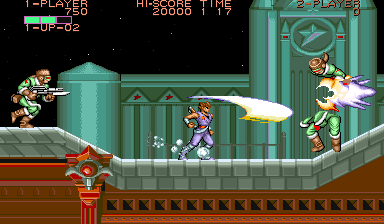
Strider Hiryu is a multi-directional scrolling platform beat-em-up in which the player takes control of 'Strider Hiryu', a ninja-style warrior who must defeat a legendary being known as 'Grandmaster Meio'.
Set in a dystopian future in the year 2048, Meio has been watching Earth from his own distant galaxy and has created a space station (known as 'The Third Moon') between Earth and its moon in order to rule over the Human race.
Armed with a curved sword known as a 'Falchion', Strider must travel the globe to find and destroy Meio. Numerous power-ups can be obtained from metallic item boxes carried by certain enemies. These include an extension to Hiryu's attack range that lasts for one hundred slashes, two types of health aids (represented by the kanji used to write Hiryu's name), a max health extension, an extra life and a power-up that not only makes Hiryu invulnerable to attack, but also increases his own attack abilities via shadow images of himself for 30 seconds.
Hiryu can also summon robotic companions known collectively as "options" that help him fight enemies. These consist of up to two mushroom-like droids, a saber-toothed tiger and a hawk. These are referred to as Options A, B and C respectively.
Strider Hiryu is highly agile and has the ability to latch onto walls and ceilings using a metallic hook; a concept which set the game apart from other platformers and allowed for highly inventive level design.
The game consists of five stages:
* Kazakh Soviet Sot Republic (called "St. Petersburgh" during the arcade game's attract sequence),
* Siberian Wilderness
* Aerial Battleship Ballog
* Amazonian Jungle
* The Third Moon.
Each stage is divided into a number of smaller sections, with each section imposing its own time limit. Strider initially has a three-point health gauge (which can be increased to five points with health extension power-ups) and will lose a life when the health gauge is fully depleted. Lives are also lost by either falling into a bottomless pit, or failing to complete a section within the time limit.
The game ends once all lives are lost, but continues are available.
- TECHNICAL -
Runs on the "CP System" hardware.
B-Board ID: 89625B-2
Players: 2 (alternatively).
Control: 8-way joystick.
Buttons: 2.
=> [1] Slash, [2] Jump
- TRIVIA -
Strider Hiryu was originally released in March 1989 in Japan. It was known there as the third video game made for this system. It is known outside Japan as just "Strider".
The title of this game translates from Japanese as 'Flying Dragon Strider'.
Known re-releases:
"Strider Hiryu [B-Board 91634B-2]" (1991)
Known export releases:
"Strider [B-Board 89624B-2]"
"Strider [B-Board 89624B-3]"
Strider became one of Capcom's early hits before "Street Fighter II - The World Warrior", revered for its innovative gameplay, multilingual voice clips during cutscenes.
Hiryu did not have his beginnings at the Arcades, but rather at the black and white pages of a manga anthology. The original Strider Hiryu manga was serialized between May and October 1988 issues of the Monthly Comp Comics and was illustrated by Tatsumi Wada (an alias of Strider's creator, Moto Kikaku or perhaps the other way around). Capcom was heavily involved in the production of the manga, which led to the creation to the later CPS game. The manga told the story of former Strider, Hiryu, who retired after killing his older sister, Mariya, who went insane for some mysterious reasons. A few years since the incident, Hiryuu is forced out of retirement by Strider director Matic when he tells the news of Kain's capture by enemy forces. The Strider Hiryu arcade game was released shortly after the manga finished it's run, although the game barely has anything to do with the plot of the manga.
As Strider was made before the fall of Communism, one could take this as a 'cold war'-era game. The main plot of the story revolves around the fact that nuclear war had broken out and a Russian secret weapon went on a rampage, the only people being able to stop it are 'Earth's Final Guardians', the Striders. Hiryu is the youngest of the Striders. Kafazu (the setting of Strider) is yet another obfuscated name (think Gotham City and New York, for you Batman fans). It's actually Kazhakstan. If you don't know what that is, it's a country in central Asia. The number of mosques in Kafazu also reflects the fact that Kazhakstan is a mainly muslim population.
Strider Hiryu was resurrected in 1998 as a character in "Marvel vs. Capcom - Clash of Super Heroes".
One of the three girls at the end of level 2 appears as a striker character (Ton-Pooh) in "Marvel vs. Capcom - Clash of Super Heroes".
Pony Canyon / Scitron released a limited-edition soundtrack album for this game (Strider Hiryu : G.S.M. Capcom 2 - D25B1001) on May 21, 1989.
- SCORING -
When you complete a level, you get the following bonus points...
1: 5,000 points
2: 8,000 points
3: 10,000 points
4: 10,000 points
5: 30,000 points
- TIPS AND TRICKS -
1 - During the game you can have the maximum of 2 'helpers'. Every time you get a helper, it will use the 'last' slot available of your life meter, or be, if you receive a damage, you will lose this life-slot and will lose your helper.
2 - Try to 'link' your helper(s) in the 'left-side' slots, because you will lose the helpers only if you get a lot of damage. On the 1st stage, be with only 2 life-slots when catching the helpers, it will maintain they more safe.
3 - If you have only 2 life-slots, and both 2 helpers, try to find the 'tiger' icon, but don't catch it. Get damage until you have only 1 life-slot. Now catch the tiger icon. The tiger will help you a few seconds, and it is over you will own the 2 helpers, but it will use only one slot, the left-slot. You will lose it only if you die (time-over not included).
4 - If you lose a life by 'time-over', your stock of 'helpers' will maintain, and it will keep on the same "slot" of the helpers.
- SERIES -
1. Strider Hiryu [B-Board 89625B-2] (1989, Arcade)
2. Strider Hiryu 2 (1999, Arcade)
3. Strider (2014, PS4, Xbox One)
- STAFF -
Object Designers : Shinji Sakashita (Sakashita Thing), Take Pong, Tissue (Tisshu), Makizoe, Tery, Terabo, Hisabo, Kuribo, Komsan, Gin
Scroll Designers : Teiki, Rie. Poo, Ziggy, Rinma, Marilyn Higuchi, Morilyn, Kintaro
Soft Programmers : T. Maruchi, Tae 250r, Mikkun, Tadaken, Kiyomi Kaneko (Kanekon), Dorompa. E, Ka~kuny, Check. Masa
Music by : Junko Tamiya
Planning Advisers : Tokuro Fujiwara (Arthur), Yossan
Game Planner : Hiroichi Yotsui (Isuke)
- PORTS -
All Japanese ports are listed here. To see non-Japanese ports, please see the 'outside Japan' version's entry; "Strider [B-Board 89624B-2]"
* CONSOLES:
NEC PC Engine Arcade CD-ROM² [JP] (sept.22, 1994) "Strider Hiryu [Model NAPR-1041]"
[JP] Sega Mega Drive (sept.29, 1990) "Strider Hiryu [Model G-4037]"
[JP] Sony PlayStation (feb.24, 2000) "Strider Hiryu 1&2 [Disc 2] [Model SLPS-02621]"
[JP] Sony PlayStation (oct.24, 2006) "Strider Hiryu [Capcom Game Books Series] [Model SLPM-87401]"
* COMPUTERS:
[JP] Sharp X68000 (1992)
- CONTRIBUTE -
Edit this entry: https://www.arcade-history.com/?&page=detail&id=2680&o=2