0.55 [David Haywood]
TODO:
* Add analog sound
WIP:
- 0.155: Basilio Garcia added clone Zero Hour (Inder).
- 0.146: hap fixed regression in Red Clash driver (hang on boot).
- 0.141u2: Andrew Welburn and The Dumping Union added clone Zero Hour (set 2). Fixed rom names. Changed parent description to 'Zero Hour (set 1)'.
- 3rd February 2011: Smitdogg - Andy Welburn dumped a previously undumped set of Zero Hour.
- 0.135u3: Fabio Priuli added driver data struct and save states to the Red Clash driver.
- 0.131u1: Angelo Salese merged memory maps in the Red Clash driver, also cleaned-up the irq/nmi generation on coin insertion.
- 0.123u2: Changed palettesize to 128 colors.
- 0.122u8: RansAckeR fixed 'Bonus Life' dipswitch.
- 0.111u4: Mike Ellery improved dipswitches in Zero Hour. Added 'Bonus Life' dipswitch. Changed 'Unknown' dipswitches to 'Unused'.
- 11th August 2005: Frank Palazzolo - I bought a Zero Hour board on eBay. Hopefully I can improve the driver when I finally get time to work on MAME again, now that I'm intimately familiar with the starfield generator circuit.
- 0.97u2: Frank Palazzolo cleaned up starfield code and fixed/added starfields to Zero Hour. Changed palettesize to 64 colors.
- 15th June 2005: Frank Palazzolo - I've hooked up the starfield generator code to Zero Hour and Red Clash.
- 3rd May 2005: Frank Palazzolo - Well, I found time to make a few more discoveries. The Space Raider boardset is 3 PCB's. Two of them are full size and obviously two halves of the same design. Then, there is a little PCB grafted on top, connected via a 24-pin dip connector, with wires going to the other two boards. I suspected that this board was the starfield generator. Sure enough, if you unplug it and run the board, the stars disappear. Cool - less work for me. Then, I noticed something else. Two chips were missing from the board, and it was labeled with the number 8011, unlike the other boards. Maybe this board is from another game? Searching through the MAME code, there is a comment that Universal game #8011 is Zero Hour. Luckily, a manual and schematics are available for Zero Hour. The starfield board is the same! In Zero Hour, this board provides both color generation and stars. The missing chips in Space Raider disable the color generation part, since that's already on the main board. Anyways, I added preliminary support for the scrolling stars to MAME, and it looks right. I need to measure a few more things to get the timing exact. When I'm done with Space Raider, I'd like to add the stars to the Zero Hour / Red Clash driver, since it's missing there as well.
- 0.72: Fixed dipswitches in Zero Hour.
- 0.55: David Haywood added 'Zero Hour' (Universal 1980).
- 30th August 2001: Nicola Salmoria improved Zero Hour.
- 27th August 2001: David Haywood added Zero Hour to the Red Clash driver, but it has some graphical issues.
Recommended Games (Star Force):
Zero Hour
Red Clash
Space Cruiser
Catacomb
Rougien
Vega
Espial
Night Star (DECO Cassette)
Nova 2001
Star Jacker
Stunt Air
Zodiack
Star Force
Alpha Mission / ASO
Alpha Mission II / ASO II
Astro Warrior (Mega-Tech)
Flower
Halley's Comet
Mission 660
Rafflesia
S.R.D. Mission
Sky Fox
Truxton / Tatsujin
Tatsujin (Tourvision PCE bootleg)
Truxton II / Tatsujin Oh
Blast Off
Blazing Lazers
GunHed (Tourvision PCE bootleg)
The Next Space
Omega Fighter
Star Fighter
Super Star Soldier (Tourvision PCE bootleg)
Lethal Thunder
Pollux
Strike Gunner S.T.G
Vimana
Explosive Breaker
Final Star Force
Galmedes
Gunlock
GunNail
Nebulas Ray
Super-X
Gekirindan
Viper Phase 1
Fever SOS
Mars Matrix: Hyper Solid Shooting
Arcade Video game published 39 years ago:
Zero Hour (c) 1980 Universal.
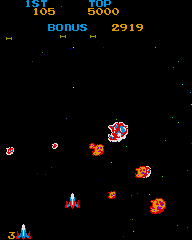
Maneuver your spaceship and destroy meteorites and enemy ships falling from the top of the screen. Shooting a red meteorite awards a quadruple score. After all enemy ships have been destroyed, a landing pad will appear where you must carefully land your ship. Bonus points are awarded for a successful landing.
- TECHNICAL -
Game ID : 8011
Main CPU : Zilog Z80 (@ 4 Mhz)
Screen orientation : Vertical
Video resolution : 192 x 240 pixels
Screen refresh : 60.00 Hz
Palette colors : 64
Players : 2
Control : 8-way joystick
Buttons : 1
- TRIVIA -
Released in December 1980.
- SCORING -
Meteorite (large) : 5 points.
Meteorite (middle) : 10 points.
Meteorite (small) : 15 points.
Enemy spaceship : 20 points.
Enemy missile : 3 points.
- SERIES -
Cosmic Series
1. Cosmic Monsters [Upright model] (1979)
2. Cosmic Monsters 2 (1979)
3. Cosmic Guerilla (1979)
4. Cosmic Alien (1980)
5. Devil Zone (1980)
6. Zero Hour (1980)
7. Space Panic (1980)
8. Cosmic Avenger (1981)
- CONTRIBUTE -
Edit this entry: https://www.arcade-history.com/?&page=detail&id=3244&o=2