Arcade Video game published 38 years ago:
Amidar (c) 1981 Konami.
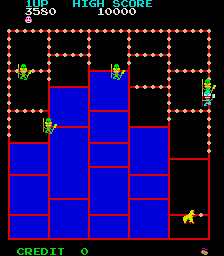
Amidar is an abstract arcade game in which players must 'colour in' all of the rectangles on the screen. Each level has a number of patrolling enemies called 'Amidars' that must be avoided but players are aided in their task with the inclusion of a JUMP button which, when used, causes all the on-screen enemies to jump, giving the player time to escape. There are only three 'jumps' given per level, however.
On odd-numbered levels, the player's character is a gorilla who eats coconuts; on even-numbered levels, it's a paint roller. The game's enemy Amidars are savages and pigs respectively. Whenever a rectangular portion of the board is cleared (either by collecting all surrounding coconuts, or painting all surrounding edges), the rectangle is coloured in and on the even levels, bonus points are awarded, while on the odd-numbered levels, points are awarded for each coconut eaten.
If players manage to fill in all four corner rectangles of a board, they are briefly able to kill the enemies by touching them (similar to the 'Power-pill' from Namco's Pac-Man series). Enemies killed in this way fall to the bottom of the screen and recover after a few seconds.
On the even-numbered paint roller levels, the roller cannot move too far from grid rectangles that have already been filled without running out of paint and having to return to completed parts of the map to refresh its supply. When this happens, any painted lines that are not part of a filled rectangle will vanish and must be painted again. This means that the player must build their completed squares around the starting point of the level and spread outwards, rather than completing squares on any part of the board as they can on the odd-numbered Gorilla levels. This makes filling in the corner rectangles to become invincible much more difficult.
In between levels players are given the possibility of earning 5,000 bonus points. Here, an Amidar moves across the top of the screen, by pushing the jump button the Amidar traces a random path down towards the bottom of the screen. If the Amidar reaches a bunch of bananas, a bonus is awarded.
- TECHNICAL -
Game ID : GX337
Main CPU : Zilog Z80 (@ 3.072 Mhz)
Sound CPU : Zilog Z80 (@ 1.78975 Mhz)
Sound Chips : (2x) General Instrument AY8910 (@ 1.78975 Mhz)
Players : 2
Control : 4-way joystick
Buttons : 1
- TRIVIA -
Amidar was released in October 1981.
Todd Lamb holds the official record for this game with 19,225,030 points.
Re-releases:
"Amidar [Re-Release]" (1982)
Licensed products:
[US] Amidar (April 1982, Stern)
[IT] Amidar (1982, Olympia)
Unofficial products:
Amigo (1982)
- UPDATES -
Japanese version : Worse attract mode and does not display the number of jumps left. Also higher scoring (20 points per coconut/segment).
- SCORING -
Collecting a coconut or painting a segment : 10 points.
Filling in a box with the paintbrush : the score in the centre of the box - 100 to 700 points.
Killing the Amidars and Tracer after filling in the corner boxes : 100 points, 200 points, 400 points, 800 points, 1,600 points, etc. 3,200 is the maximum on later levels (only in the Japanese version).
Collecting the bonus banana on the interim level : 5,000 points.
- TIPS AND TRICKS -
* The Tracer always follows the outside edge and is easy to avoid. Try to ensure it is within range when you complete the fourth corner box of the maze, making it easy to kill.
* The Amidars all have a set movement pattern, which is detailed by the 'Amidar movement' on the title screen. They only move in 4 ways :
a) up/right,
b) up/left,
c) down/right
d) down/left.
They will follow their current pattern of movement (a, b, c or d) until they reach the edge of the maze when they move round the edge of the last box they contact and continue with their new pattern. e.g. Up/right to the top right of the maze, round the last box and then down/left to the bottom left corner. Mastering their pattern of movement is the key to success!
* If all Amidars are close to the bottom of the screen on the coconuts level, they will take a while to make it to the top. Use this time to clear as much of the top area as you can.
* Remember you have three jumps available on each level so make use of them to get yourself out of a tight corner. Two quick jumps if used in succession will easily give you enough time to get well clear of any danger.
- PORTS -
* CONSOLES:
Casio PV-1000 [JP] (1983)
* COMPUTERS:
BBC B [EU] (1983) "Crazy Tracer" by Acornsoft
BBC B [EU] "Crazy Painter" by Superior Software
BBC Electron [EU] (1983) "Crazy Tracer" by Acornsoft
[EU] Sinclair ZX Spectrum (1983) "Colour Clash" by Romik Software
Sinclair ZX81 [EU] (1983) "Damper" by Quicksilva
[EU] Commodore C64 (1984) "Rollin" by Atlantis Software
* OTHERS:
VFD portable game [JP] (1981) by Gakken.
VFD portable game [JP] (19??) by CGL (Gakken clone).
- CONTRIBUTE -
Edit this entry: https://www.arcade-history.com/?&page=detail&id=80&o=2