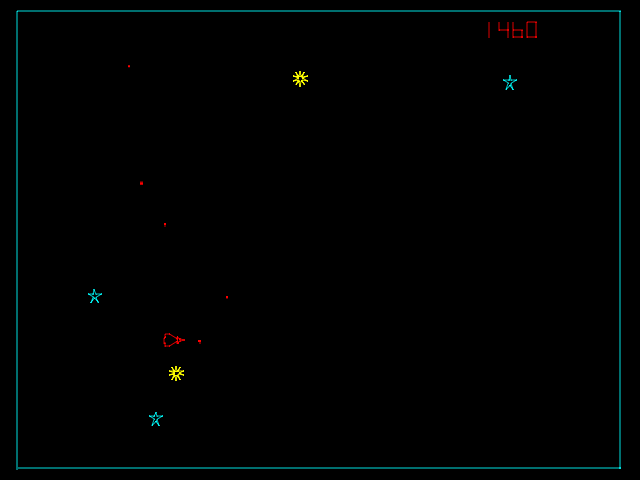
Arcade Video game published 37 years ago:
Space Duel (c) 1982 Atari.
Space Duel is a 1- or 2-player game with a color X-Y video display. This display, with its 3-color guns and higher voltage, has the same technology that was used in previous Atari black-and-white X-Y displays. However, the screen now displays dazzling color and unique visual effects in a spectacular multi-dimensional video display.
Space Duel offers players a choice of 4 different game versions. One player can control a fighter or a space station. Two players, playing at the same time, can control fighters or a space station. The game offers players 12 different targets (7 split when hit), and 18 different waves. At the beginning of each wave, objects enter from the screen edge. The player(s) then tries to shoot and destroy the objects. The wave ends when all the objects are destroyed.
Gameplay begins with the first wave. In the space station game, two ships appear near the center of the screen. The ships are joined together by a 'fuse'. In the fighter game, the red ship appears above the red controls. The green ship appears above the green controls. A sound is heard any time a ship appears on the screen.
A ship may fire as many as four shots on the screen at one time. However, if a ship is damaged, it may fire only one shot on the screen. Also the ship is slower to react. In space stations, a second hit to either ship destroys that ship. Then, the fuse between ships starts to burn, and the other ship explodes.
In the fighter game, players may shoot each other without losing a life. Instead, the ship blinks and disappears. After a period of time, the ship reappears in a different location. If one player loses all of his ships before the other player, his last ship returns to the screen as a damaged ship. It is possible to earn a bonus ship while damaged.
Shields protect a ship from all saucer shots and collisions. Shields wear out with time or if hit by targets. Space stations have more than twice as much shield energy as fighters.
In the first wave, spinners enter and break into two smaller pieces when shot. Each piece splits into two smaller pieces when shot again. Each of these pieces is destroyed when shot. Other targets split apart in the same manner.
At the end of each wave, a bonus wave begins and a low humming sound is heard. 'BONUS LEVEL', and the number of points for that level, flash on the screen. A box appears at the screen edge and ships cannot leave that boundary. Fuzzballs, stars and saucers enter and attack the player. A fighter, when shot by the other player, either just before or during the bonus wave, will not reappear until the next wave. The bonus wave ends when all targets are destroyed, or the humming sound reaches its highest pitch.
Other targets enter as the game progresses. When the number of targets is less than the wave number, or if no splitting targets have been hit in some time, saucer enters and shoots at targets and ships. The saucer shots become more accurate as play continues. Saucers may also enter as a pair. They shoot at, but do not destroy, each other. Anything caught between them will be shot. Each time the pair goes across the screen, the distance between them increases.
A player's ship may be destroyed by a shot or collision. The game is over when all ships are destroyed.
- TECHNICAL -
Game ID : 136006
Main CPU : MOS Technology M6502 (@ 1.512 Mhz)
Sound Chips : (2x) POKEY (@ 1.512 Mhz)
Player controls consist of 5 buttons for each player :
ROTATE LEFT
ROTATE RIGHT
THRUST
SHIELDS
FIRE
- TRIVIA -
The Upright model was placed on Field Test for the first time on July 31, 1981. It was officially released in February 1982.
Production run :
Space Duel Upright : 11,017 Built @ $2,095
Space Duel Cocktail : 1,019 Built @ $1,895
Space Duel is the first and only multi-player interactive vector game by Atari. When "Asteroids Deluxe" tanked, this game was taken off the shelf and released to moderate success.
A Space Duel cabinet appears on the cover of the Who's 1982 album, 'It's Hard'.
In 1982, Atari released a set of 12 collector pins including : "Missile Command", "Battle Zone", "Tempest", "Asteroids Deluxe", "Space Duel", "Centipede", "Gravitar", "Dig Dug", "Kangaroo", "Xevious", "Millipede" and "Food Fight".
- TIPS AND TRICKS -
* Invite Your Friend : In 2-player mode, you can shoot your partner and it will regenerate their shield. This comes in very handy!
- SERIES -
1. Asteroids (1979)
2. Asteroids Deluxe (1981)
3. Space Duel (1982)
4. Blasteroids (1987)
5. Asteroids (1998, PC, PS; 1999, GBC; 2000, Mac)
6. Asteroids Hyper 64 (1999, N64)
7. Asteroids Gunner (2011, App Store)
- STAFF -
Designed & partially programmed by : Rick Maurer (Richard Maurer)
Project resumed, changes made & game finished by : Owen Rubin (ORR), (JMR), Steve Calfee (SRC), Dave Shepperd (DES)
Hardware Engineer : John Ray
- PORTS -
* CONSOLES:
[US] Sony PlayStation (2001) "Atari Anniversary Edition Redux [Model SLUS-01427]"
[EU] Sony PlayStation (mar.1, 2002) "Atari Anniversary Edition Redux [Model SLES-03808]"
[US] Microsoft XBOX (nov.16, 2004) "Atari Anthology [Model 26084]"
[US] Sony PS2 (nov.22, 2004) "Atari Anthology [Model SLUS-21076]"
[EU] Microsoft XBOX (nov.26, 2004) "Atari Anthology"
[EU] Sony PS2 (feb.18, 2005) "Atari Anthology [Model SLES-53061]"
[JP] Microsoft XBOX (aug.4, 2005) "Atari Anthology [Model B7X-00001]"
[US] Sony PlayStation 4 (oct.18, 2016) "Atari Flashback Classics Vol.1"
[US] Microsoft XBOX One [US] (nov.1, 2016) "Atari Flashback Classics Vol.1"
* HANDHELDS:
[US] Nintendo DS (nov.2, 2010) "Atari Greatest Hits Vol.1 [Model NTR-BR6E-USA]"
[EU] Nintendo DS (feb.24, 2011) "Atari Greatest Hits Vol.1 [Model NTR-BR6P-EUR]"
* COMPUTERS:
[US] PC [MS Windows, CD-ROM] (nov.11, 2003) "Atari - 80 Classic Games in One! [Model 25069J]"
[EU] PC [MS Windows, CD-ROM] (june.10, 2005) "Atari - 80 Classic Games in One! [Replay]"
[US] Steam (mar.24, 2016) "Atari Vault [Model 400020]"
* OTHERS:
[US] Atari Flashback 2 (2005) - Atari 2600 version
[US] Nokia N-Gage (feb.2006) "Atari Masterpieces Vol. II"
[EU] Nokia N-Gage (mar.30, 2006) "Atari Masterpieces Vol. II"
[US] "Atari Flashback 2+" (2010) - Atari 2600 version
Apple Store [US] (2011) "Atari Greatest Hits"
Android Market [US] (2011) "Atari Greatest Hits"
- CONTRIBUTE -
Edit this entry: https://www.arcade-history.com/?&page=detail&id=2525&o=2