Arcade Video game published 30 years ago:
JuJu Densetsu (c) 1989 TAD.
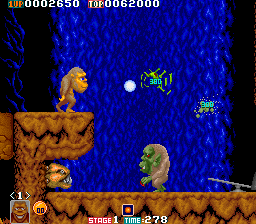
The game is a typical platformer in which the player must traverse several levels with a miniboss at the end. Despite his apparent handicap - his slowness as an ape - and the fact that almost any attack can kill him, Toki is able to spit powerful shots that will help him in defeating enemies and obstacles that try to slow him down in his mission. There is a timer for each stage.
JuJu can make use of items such as power-ups for his spit: lucky rabbit feet which can give Toki bursts of super-human agility and jumping skill, clocks which add extra time to the countdown, fruit which can add to JuJu's bonus points, keys which unlock bonus areas, a special helmet that protects him from upwards attacks, extra lives, and magic coins which when collected in abundance can obtain Juju an extra life.
- TECHNICAL -
Main CPU : Motorola 68000 (@ 10 Mhz)
Sound CPU : Zilog Z80 (@ 4 Mhz)
Sound Chips : YM3812 (@ 3.579545 Mhz), OKI6295 (@ 8 Khz)
Players : 2
Control : 8-Way Joystick
Buttons : 2
=> Spit, Jump
- TRIVIA -
According to the TAD president, Tadashi Yokoyama: One day in December 1988, a freelance artist came at TAD with a portfolio of designs including this monkey. The team was motivated to do a game around this funny monkey.
On February 02, 1989, the first prototype was ready: one level, no enemies, no musics and the monkey can jump only (no shoot). At this point, they decided to reprogram the game entirely from 0. Note JuJu Densetsu was coded with the same system used by the neogeo coders at SNK.
During the first location test (at the TAD office) on September 07, 1989, many new ideas came to the developers but most of them were not included in the final product (i.e: snakes on the first stage), because lack of time.
On September 15, 1989. a public location test was done in Japan AND in the USA (University of Washington). A second test was done in October. After this test, they decided to program the end of the game (done by a non-programmer in a week-end). Note: The girl you have to save is brune in the attract mode and blonde at the end.
The game was finished on November 06, 1989.
Then, after about 10 months of development, JuJu Densetsu was finally released on December 08, 1989 in Japan by TAD. 3148 arcade boards were sold. Export releases: "Toki".
The title of this game translates from Japanese as 'Legend of JuJu'.
The devil monkey with horns from the level 2 is called Bellzador (Dev. code name: Akuma Zaru) and has the most complex AI routine. It takes 27 pages 'A4' format in the source code. Its desing and patern were inspired by Red Arremer from Makaimura.
There is some unused sprites for the character's animation in the game code.
On February 26, 1990, TAD know that pirate versions of their game appear on the market.
This was the last video game developed by TAD. A sequel was planned (JuJu 2! an action puzzle game) for the Super Famicom but the company closed its door 2 months after the JuJu Desnsetsu release. Fortunately, the source code of JuJu 2 was sold to Altron Corp. who released the game as "Little Magic [Model SHVC-LI]".
- TIPS AND TRICKS -
BAD ENDING
----------
You can reach a 'Bad Ending' if you died last life (After the 5th continue) in Stage 6 (Final Stage).
DEBUG MODE
----------
Mr. Akira Sakuma, programmer of this game, divulged this trick in October 2015. 26 years after the release in Japan!
In order to access the JuJu Densetsu hidden Debug Mode: use a hex editor, and open the file k10_4e.bin, and at offset $244, replace the '00' by '0F'.
On screen you have then the following:
AXX
BXX
MXX
TXX
IXX
A is corresponding to the visible enemies on screen
B is corresponding to the enemies loaded in memory but not visible on screen
M is corresponding to the number of enemies projectiles/shots on screen
T is corresponding to the Traps sets on screen
I is corresponding to the Items visible on screen
- STAFF -
Game Designer: Haruki Kitahara (Kitahara)
Programmers: Akira Sakuma (Sakuma), Takashi Nishizawa (Nishizawa), Tsukasa Aoki (Aoki)
Graphic Designers: H. Kakiuchi (Kakiuchi), Junichi Fujisaku (Fujisaku), Jun Matsubara (Matsubara)
Musics & Sound: Yusaku Aoki, Yukihiko Kitahara
- PORTS -
* CONSOLES:
[JP] Nintendo Famicom (jul.19, 1991) "JuJu Densetsu [Model DTF-5J]"
[JP] Sega Mega Drive (jan.31, 1992) "JuJu Densetsu [Model G-4064]"
- CONTRIBUTE -
Edit this entry: https://www.arcade-history.com/?&page=detail&id=1235&o=2