Arcade Video game published 37 years ago:
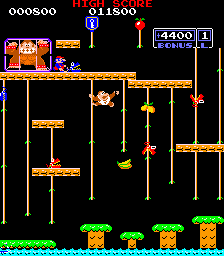
Donkey Kong Jr. (c) 1982 Nintendo.
Something of a role reversal for this superb sequel to the seminal 1981 platform-based original, with Mario now cast as the villain (the only Mario game in which this occurred) and Donkey Kong cast as the captured victim.
Donkey Kong's son, DK Jr., must rescue his captured father from Mario's clutches by climbing and jumping his way over vines, chains and platforms before he can reach his father. Jr. has to race against time while avoiding the horrible Snapjaws, Nitpickers, and Sparks released by Mario.
Like the original, Donkey Kong Jr. features four different stages, but in the US version, one or both of the middle stages are omitted in the first three levels. In the Japanese and bootleg versions, all four stages are played in their logical order. Please refer to the "Donkey Kong Junior" (North American version) entry, Updates section, for complete details.
- CAST OF CHARACTERS -
Donkey Kong Jr. - The baby ape in the white unitard with a big J printed on the front, this is the son of Donkey Kong and he must rescue his father from Mario's cage.
Mario - This game is quite possibly the ONLY game in Mario's long history where he is the enemy.
Donkey Kong - Poor DK was captured by Mario after the events portrayed in Donkey Kong. Now he must helplessly watch as his son comes to the rescue.
Snapjaws - These mechanical mouths must be avoided. Blue Snapjaws will drop down a vine and continue to fall off the screen, while Red Snapjaws will climb back up a vine and pose a more permanent threat.
Nitpickers - There are two types of Nitpickers in the game. Small Nitpickers appear on the Springboard Stage and occasionally drop eggs on Jr. as they fly around the top branch. Large Nitpickers appear on the Chains stage and weave back and forth in an attempt to hinder Jr.'s chances at rescuing his father.
Sparks - These volts of electricity patrol the Mario's Hideout Stage. The red variety follows the loop that they begin on while the blue version follows the vertical strips from one level to the next as they drop to the bottom of the screen.
Fruit - Jr. will find various pieces of fruit scattered throughout each stage that he will pluck when he touches them. The fruit will fall and take out any enemy in its path until it reaches the bottom of the screen. They are one of the best sources for bonus points.
Keys - On the first three stages, Jr.'s goal is to reach the key at the top of the stage. Once he jumps onto the vine or chain with the key at the top, he automatically climbs it to the adjacent platform and advances to the next stage. On the Chains Stage, Jr. must push six keys up the chains into the locks positioned at the top of the stage. When all six keys are inserted into the locks, Papa will be set free.
- TECHNICAL -
Main CPU : Zilog Z80 (@ 3.072 Mhz)
Sound CPU : I8035 (@ 400 Khz)
Sound Chips : DAC
Players : 2
Control : 4-way joystick
Buttons : 1 (JUMP)
- TRIVIA -
Donkey Kong Jr. was released in August 1982 in Japan.
The US version, as well as some bootleg versions, have the suffix fully spelled out in the printed title rather than abbreviated ("Donkey Kong Junior").
The music that is played in the intro sequence before gameplay is the opening of Bach's 'Toccata and Fugue in D Minor'.
The song that is played during the cut scene before the Mario's Hideout Stage is from the 'Can-Can'.
Steve Wiebe holds the official record for this game with 1,139,800 points on March 14, 2009.
Bootlegs of the game include "Donkey King Jr." and "Junior King". Another bootleg runs on the "Moon Cresta" hardware.
- UPDATES -
The 'Extra Lives' dip switch can actually be set to 10,000, 15,000, 20,000, or 25,000; the default is 10,000.
- SCORING -
Jump over one opponent : 100 points
Jump over two or more opponents : 300 points
Pick a fruit : 400 points
Hit first opponent with fruit : 800 points
Hit second opponent with fruit : 1,200 points
Hit third and subsequent opponents with fruit : 1,600 points
On the Chains Stage only :
Push key in lock : 200 points
- TIPS AND TRICKS -
* When you start the game, Jr. will start at the bottom left corner of the Vines Stage. Your job in the first three stages is to navigate him to the key at the top of the screen so that he can progress to the next stage. Here are some strategies for each stage...
* VINES STAGE : This is the first stage of each level.
1) To start out, Jr. must grab the vines above him, and climb up to one of the two ledges to his right. He can jump to the next vine from either ledge, where he must slide down to the tree top below.
2) Carefully jump right from one tree top to the next before grabbing the fourth vine from the right. Climb up above the right ledge and maneuver Jr. over to the far right vines. Climb up and onto the branch above. Jump over any Snapjaws that pose a threat and leap up to the higher section of the branch before leaping for the key and ending the stage.
3) Along the way, the pear and apple fruit prizes should be plucked with ease, and if you have time, it pays in the early levels to eliminate any of the Red Snapjaws since they won't come back. However, from L5 onward, they will regenerate at Mario's feet. The banana is in a precarious position and should only be plucked if time and safety permits.
* SPRINGBOARD STAGE : This stage earns its name by hosting a springboard at the bottom of the screen. Its purpose is to provide Jr. with a shortcut.
1) Ordinarily, Jr. must jump on the springboard to reach the treetop on the opposite side. Then he must ride the moving platform to the right and climb up the chains beneath the pulley. He must step onto a ledge which is placed directly beneath the point at which Small Nitpickers like to lay eggs, so watch out. Then he must jump to the left to reach the first hold. When the small platform is beneath him, he must drop down and let it carry him to the next hold which rises and falls.
2) If Jr. uses the springboard as a shortcut, he can move directly from the start to this small ledge by pressing the jump button at precisely the moment when he hits the springboard, and he will launch up to the small platform immediately.
3) Jr. can only jump up and grab the second hold when it is in its lowest position. Once he safely has it, he must reach left and grab the chains that extend below Papa. After pulling himself up, he must navigate through the gauntlet of Small Nitpickers to reach the chains on the right side, where he must climb up a little further to reach the branch. Jumping over the gap in the branch, and timing his jumps to ensure that he doesn't collide with any Small Nitpickers, he can reach the key and end the stage.
* MARIO'S HIDEOUT :
1) The layout of this electrically-filled chamber is substantially simpler than the previous stages, but it poses an even greater threat. Not only are Sparks a danger to Jr.'s feet on the ground, they also pose a danger when they pass overhead. A nervous player may anxiously jump over a Spark only to realize too late that another spark was headed Jr.'s way above him. The route is simple. From the start, cross over to the right, climb up, cross back over to the left, climb up, cross once more to the right, climb up again, and finally back to the left in an effort to reach the key.
2) While the Red Sparks remain in their loops, the Blue Sparks move from the top of the screen to the bottom, taking the blue vertical pathways along the way. In the beginning, a Blue Spark will randomly choose one of the four pathways beneath Mario, so cross below Mario with care.
3) The apples are easily plucked on each level, but nailing Sparks with them will take extra timing, and may put you in a bad position if you're not aware of your surroundings.
* CHAINS STAGE : This is Jr.'s last chance to save Papa, so it's now or never.
1) Papa's cage is positioned above a set of six locks, and the keys to those locks are located on chains directly below them. All Jr. has to do is push those keys up and insert them into all six locks and grant Papa his freedom.
2) Blocking his way will be stubborn Red Snapjaws and Large Nitpickers that Mario sends after Jr. The Large Nitpickers will fly from one end of the screen to the other before swooping down a level and reversing direction.
3) Obviously it is faster for Jr. to push up keys two at a time when the chance is available, but that exposes Jr. to twice the danger as Red Snapjaws could be located on either chain at any given moment. So proceed with caution, and try to save the apples for the moments when the Red Snapjaws are located beneath them and can be done away with for bonus points. But from L5 onward, beware...as in the Vines Stage, Red Snapjaws will regenerate at Mario's feet.
4) Once Jr. unlocks every lock, Papa will come tumbling down and mighty Jr. will catch him before the game starts all over again from the Vines stage at a more difficult level.
- SERIES -
1. Donkey Kong (1981)
2. Donkey Kong Jr. (1982)
3. Donkey Kong 3 (1983)
- STAFF -
Designed & programmed by : Shigeru Miyamoto, Masao Yamamoto, Kenji Nishizawa, Masayoshi.O, H. Hoshino
Music by : Hirokazu Tanaka
Produced by : Gunpei Yokoi
- PORTS -
NOTE : For ports released in North America, please see the North American version's entry.
* CONSOLES:
Atari 2600 [EU] (1982)
[JP] Nintendo Famicom (jul.15, 1983) "Donkey Kong Jr. [Model HVC-JR]"
[EU] Nintendo NES (june.15, 1987) "Donkey Kong Jr. [Model NES-JR-EEC]"
Nintendo Famicom Disk [JP] (jul.19, 1988) "Donkey Kong Jr. [Model FMC-JRD]"
* COMPUTERS:
BBC Micro [EU] (1984)
- CONTRIBUTE -
Edit this entry: https://www.arcade-history.com/?&page=detail&id=668&o=2